
- 14 April 2026
- No Comment
- 322
They Started With One Gig | They Ended Up With a Company
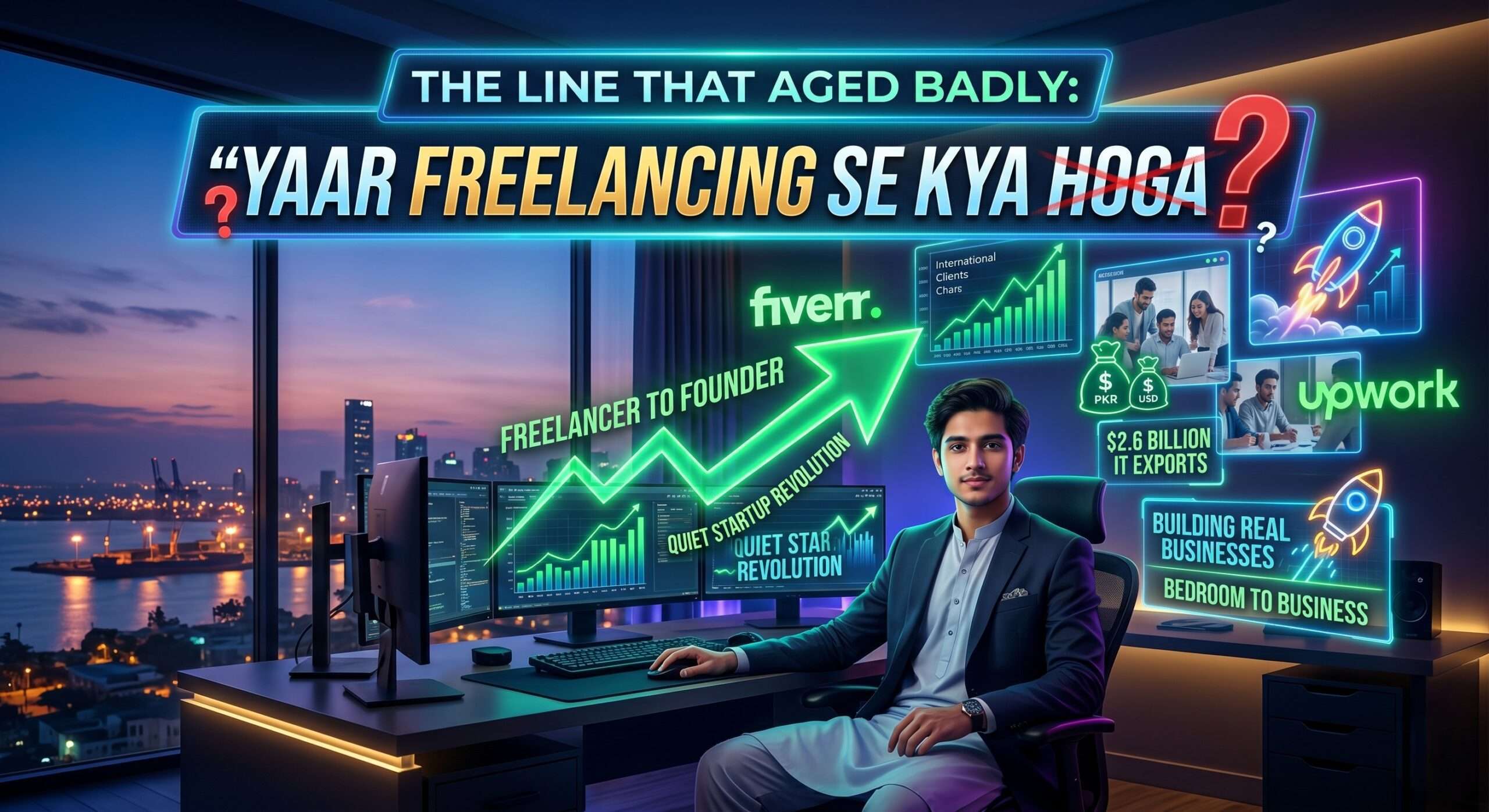

The Line That Aged Badly “Yaar Freelancing Se Kya Hoga”
Let me start with a sentence almost every Pakistani freelancer has heard at least once.
“Yaar yeh Fiverr-Viverr se kya hoga, koi proper kaam find karo!”
Maybe it was your father. Maybe a relative at Eid dinner. Maybe a classmate who got placed at a firm and suddenly became a career counsellor. Whoever said it, the message was the same: freelancing is not serious. It is not real. It is something you do when you have nothing better going on.
I used to hear this too. And for a while, honestly, I believed it.
But then something started happening around me, and I think it is happening across Pakistan right now that made me realize how badly that advice has aged.
The boy who was doing logo work on Fiverr for five dollars ($5) in 2019 now runs a design studio with a team of four. The girl who was writing product descriptions for US clients on Upwork while studying for her exams now manages content operations for three different brands. The developer who was “just doing freelance” is selling a software product to SMEs across three countries.
Nobody gave them seed funding. Nobody accepted them into an incubator. Nobody even called what they were doing a startup.
But that is exactly what it became. Simple J
The Number First: Because This Is Bigger Than Most People Think
We know that Pakistan is one of the top freelancing countries in the world. It happened only because of millions of individual decisions, young people, often with no resources and no connections, who decided to sell a skill online instead of waiting for someone to give them a job.
Today Pakistan ranks among the top four freelancing countries globally. The Pakistan Software Export Board recorded IT and freelancing exports crossing $2.6 billion in 2023–24. The State Bank reported over 20% growth in IT remittances through formal banking channels. Fiverr has publicly identified Pakistan as one of its fastest growing seller markets in South Asia.
But here is the part that does not make headlines: a meaningful portion of those top earners are not just freelancing anymore. They have started hiring. They have started packaging. They have started building.
The freelancer to founder shift is real. It is quiet. And it is reshaping what the next generation of Pakistani startups will look like.
Three Stories That Explain What Is Actually Happening
I want to tell you about three people. Not famous people. Not startup poster boys. Just real individuals whose journeys follow a pattern I have seen repeated too many times to ignore.
Story 1 Abdul Hafeez: The Developer
Hafeez had been doing WordPress development for foreign clients for years. E-commerce setups, payment gateway integrations, custom plugins, he had seen the same problems come up again and again, especially for Pakistani SMEs trying to sell online.
The tools that existed were either too expensive, too complex, or simply not built for the Pakistani market. Payment gateways that did not integrate properly. Logistics plugins that had no local support. Checkout flows designed for customers in the US, not in Karachi.
So Hafeez built something. A lightweight plugin that solved these specific problems for a specific market. He priced it to be actually affordable for local businesses. He sold it first to his existing clients, then started marketing it himself.
He now earns recurring subscription revenue. Not massive numbers yet. But the business runs without him doing hourly work. That distinction, income that does not require his constant presence is the single biggest line between freelancing and building a product company.
Story 2 Yasir Memon: The Blogger
Yasir is from Gulshan-e-Hadeed, Karachi. Not Defence. Not Clifton. Gulshan-e-Hadeed, a place most people in the startup world have probably never visited, let alone thought about as a source of digital business.
He started a tech and gadgets review blog. Simple enough. He interested writing about phones, earbuds, laptops, the stuff he genuinely used and cared about. At first it was just a normal hobby. He just liked the idea that people were reading what he wrote.
Then his brother Shahzad Bashir Memon Suggested Affiliate Marketing. If someone clicked his link and bought the product, he got a commission. Small amounts at first a few hundred rupees here, a thousand there. But the traffic kept growing because his reviews were honest. He was not writing what brands wanted to hear. He was writing what buyers actually needed to know. And people could feel the difference.
Log kehte the “Yaar blog se kya milega?” Yasir kehta tha “Dekho, kya kya milta hai.”
Today Yasir manages a content and affiliate team of eight people. Most of them are young, fresh, Gen Z minds, friends, a cousin who was doing nothing after matric, a friend who turned out to be a surprisingly good content writer. Nobody had a degree. Nobody came with a portfolio. But Yasir gave them a system, trained them in what he had learned himself, and built something real from scratch.
Eight people. From a blog. From Gulshan-e-Hadeed. If that is not a startup, I genuinely do not know what is.
Story 3 Saad: The Designer
Saad was a graphic designer lived in Faisalabad. He made a Fiverr account because rent was becoming a problem and he had skills. Nothing dramatic. Just necessity meeting opportunity.
His early gigs were logo packages cheap, fast, and honestly a little generic. But he was consistent. He communicated well. He delivered on time, every time. And slowly his reviews started doing the selling for him.
Then clients started asking for more. Social media graphics. Pitch decks. Brand guides. Things that were outside the original gig but inside his capability.
He hired a junior designer to handle the repetitive work. Then a copywriter. Then someone for client communication. He started calling it a studio first as a joke, then as a real description of what it had become.
He did not plan any of this. There was no business plan, no funding round, no mentor advising him on growth strategy. The business grew because he kept saying yes to the right things and built systems to handle what he could not do alone.
That is entrepreneurship. That is just what it looks like when it starts from a bedroom instead of a co-working space.
Why CA Students Have an Edge Nobody Is Talking About
Here is an honest observation, and I say this as someone who is both a CA student and has freelanced since 2018.
Most young founders in Pakistan struggle not because of lack of ideas, but because of lack of financial discipline. They do not know how to price properly. They confuse cash flow with profit. They scale before they are stable. They do not track expenses. And then one day the business that was growing starts bleeding, and they do not even understand why.
CA students do not have this problem. Or at least, they should not.
We know what a balance sheet looks like. We understand debtors and creditors before we ever have any. We have studied Partnership Acts and company law and tax structures, things most entrepreneurs only learn about when they are already in trouble.
Now imagine combining that with actual freelancing experience. Not just book knowledge but real experience of winning clients, delivering work, managing stress and difficult situations, handling your own self earned income, and surviving in a competitive global market.
That combination is genuinely rare. And it is incredibly powerful for building a sustainable business.
The CA qualification teaches you how money moves. Freelancing teaches you how business actually feels. Put those two things together and you are not just a student anymore, you are a founder waiting to happen.
The 8 Signs You Are Already Building Something; You Just Have Not Admitted It Yet
A lot of freelancers are already functioning like founders without realizing it. Here is a simple checklist. Be honest with yourself while reading these.
- Your clients come back without you chasing them. Repeat clients mean trust. Trust is your brand. Your brand is your business.
- You have ever hired or subcontracted someone. The moment you paid another person to help you deliver work, you became an employer. That is a business behavior.
- You charge per project or per month not per hour. Hourly billing is time for money. Project or retainer billing is value-for-money. That shift in thinking is everything.
- You have a process, not just a habit. If you onboard clients the same way every time, if you have templates, if there is a system, you are running operations, not just doing work.
- People refer others to your name or brand. Word of mouth is marketing. Marketing builds brands. Brands outlast their founders.
- You know your numbers. Monthly income. Monthly expenses. What you actually keep. If you know this, you think like a CFO even if nobody gave you that title.
- You have thought about where this could go. Not just next month. Three years from now. That is a founder mindset, full stop.
- Your income can survive a week off. If the money stops the moment you stop working, you have a self-employed job. If something keeps moving even when you step back that is a business.
The Part Nobody Warns You About The Mindset Problem
Honestly, the skills are the easy part. You can learn SEO, you can learn design, you can learn development. These things take time but they are learnable. The hard part is mental.
Freelancers are trained by the market, by client reviews, by survival to be agreeable. Say yes. Deliver fast. Never push back. Make the client happy even when the client is wrong. This works well when you are trying to build a reputation on Fiverr.
It is genuinely dangerous when you are trying to build a business.
Founders have to say no. To bad clients, to low-value projects, to opportunities that look good but take you in the wrong direction. They have to charge what they are worth even when it feels uncomfortable. They have to sometimes let a client go so they have capacity for a better one.
This is the shift that breaks most people. Not the skills, not the knowledge the permission to think bigger than the next gig.
Freelancer kehta hai yeh kaam karo, paise milte hain.
Founder kehta hai yeh kaam karo, kyunki yeh mujhe wahan le jata hai jahan mujhe jana hai.
That difference in how you choose your work is, ultimately, the difference between a gig and a company.
Conclusion: Pakistan’s Next Startups Will Not Come From Where You Expect
We talk a lot about startup ecosystems. Incubators. Accelerators. Pitch competitions. Venture capital. As if the only valid origin story for a business is the one where someone stands in front of a panel and asks for money.
But the truth the one playing out in bedrooms and home offices and co-working spaces in Lahore, Karachi, Islamabad, Faisalabad, and every city, town and village in between is different.
Pakistan’s next generation of startups is being built by people who started with one skill and one client. Who reinvested their first earnings into better tools? Who hired their first team member before they had a company name? Who are profitable before they ever heard the word “runway?”
They are not waiting for permission. They are not waiting for funding. They are already building quietly, consistently, and without much fanfare.
And if you are a student who has ever worked as a freelancer, or is thinking about it please understand this: you are not behind. You are not wasting time. You are building something the market will eventually reward, even if it does not feel like it right now.
The startup was there all along. You just called it freelancing.
Duniya jo startup dhundh rahi thi woh tumhare laptop mein already chal raha tha. Find it !!
Author: Arsalan Ali
Level: CAF (ICAP)
This article is submitted by the author as part of the Nashfact National Writing Competition. Views expressed are the author’s own.