

- 8 May 2026
- No Comment
- 332
How US–China Tensions Are Reshaping Pakistan’s Economic Stability

Author: Saif ul Malook
Level: CAF (ICAP)
This article is submitted by the author as part of the Nashfact National Writing Competition. Views expressed are the author’s own.
The Pain at the Petrol Pump
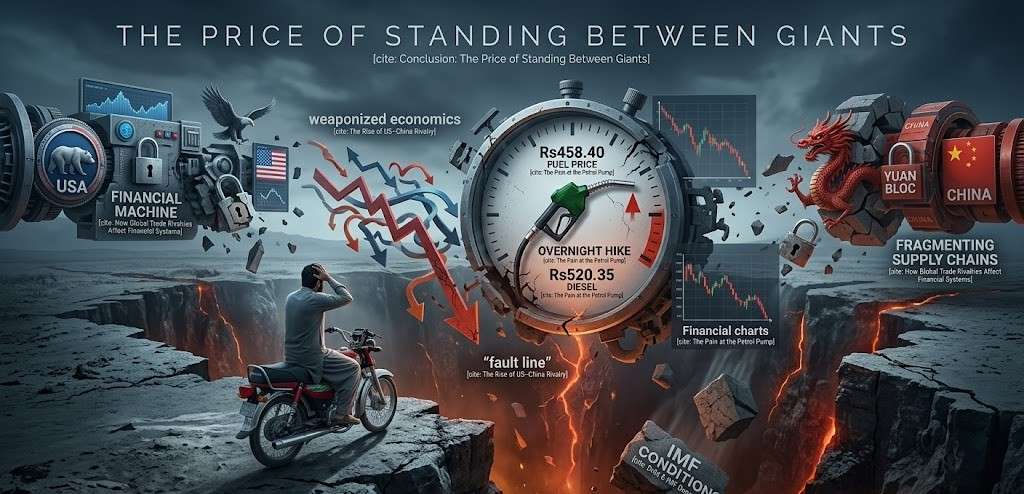
Let me start with something we all felt recently. On April 3, 2026, millions of Pakistanis woke up to a gut punch. Overnight, the price of petrol was supposed to go down? Haha, no. Actually, the government raised petrol to Rs458.40 per litre and high-speed diesel to Rs520.35. If you ride a motorbike to work as half the country does, that Rs137 hike meant you were suddenly paying almost 43% more just to get to your job. My cousin in Lahore called me that morning absolutely furious. I didn’t blame him.
Then a day later, in a move that felt like political whiplash, the Prime Minister cut the petroleum levy and dropped petrol back to Rs378.41. The Finance Minister later admitted the government had already spent Rs129 billion (around $458 million) in just three weeks just to shield us from the full shock. Three weeks. One hundred twenty-nine billion rupees.
Here’s my question: why are we, a nation that produces neither the oil nor the political rivalries, always stuck holding the bill?
The answer isn’t just in global oil charts, although that’s part of it. The answer is locked in the escalating economic rivalry between the United States and China. And this rivalry isn’t happening “over there.” It’s happening right here, in our import bills, our shrinking foreign reserves, and the impossible conditions the IMF keeps piling on us like bricks.
The Rise of US–China Rivalry
Alright, let’s take a step back. I’m aware geopolitics often carries the reputation of being abstract, or worse, sleep-inducing, but stay with me; this actually matters.
The relationship between the world’s two largest economies has moved from “strategic competition” to outright financial warfare. Like, actual weaponized economics.
Back in April 2025, President Trump declared something called “Liberation Day”. A dramatic name, I know. Slapping a baseline 10% duty on most imports and then piling on extra “reciprocal” tariffs .For China, the escalation was immediate and brutal. US tariffs on Chinese goods eventually hit a staggering 145 percent at one point, with China firing back duties up to 125%. By mid-2025, the average two-way tariff rate peaked at 164% from the US side and 146% from China, before settling around 39% and 31% respectively later that year. Let that sink in. We’re talking about tariffs that make normal trade almost impossible.
The tech fight is even more personal, honestly. The US has turned semiconductors into a battleground using export controls to choke China’s access to advanced chips. But here’s a weird twist I found fascinating: while the US banned Nvidia’s advanced chips, by July 2025, they quietly allowed the sale of “compliant” ones but only if the US government got a direct 15% cut of the revenue. Fifteen percent just for permission. That’s not trade policy. That’s ransom.
These aren’t just geopolitical maneuvers happening in Washington and Beijing. These are tectonic shifts cracking the foundation of global supply chains. And we’re sitting right on top of the fault line.
How Global Trade Rivalries Affect Financial Systems
The United States & China trade tension isn’t just hurting them. It’s breaking the global financial machine in three specific ways that directly punch Pakistan in the gut.
First, global trade is actually shrinking. Major institutions project global trade volumes to decline by 0.3% in 2026. That doesn’t sound like much, but when the global pie shrinks, everyone fights harder for crumbs. And we’re not exactly the biggest kid at the table.
Second, supply chains are fragmenting. China’s exports to the US are projected to drop 18% by 2026. So what does China do? It pivots aggressively toward ASEAN and Europe. That redirection means more Chinese goods competing with ours in third markets. Our textiles vs Chinese electronics in African markets? We lose that fight most days.
Third, and this is the most dangerous one for us, capital is fleeing to safety. When uncertainty spikes, global investors dump emerging market currencies and scramble for US dollars. The result? A stronger dollar crushes currencies like the Pakistani Rupee, making our dollar-denominated debt even more expensive to service. It’s a vicious cycle and we’re trapped in it.
Impact on Pakistan’s Economy
Trade & Exports
The figures here are stark and frankly, a bit depressing.
Pakistan’s goods trade deficit widened to $18.4 billion in the first seven months of FY26, compared to just $14.1 billion last year. Imports jumped nearly 10% while exports actually slipped slightly. Our textile sector, the backbone of our exports, the thing we’re actually good at had managed only a 10% increase. That wasn’t nearly enough to stop the bleeding.
Here’s a bigger number that kept me up at night: the trade deficit during July-February FY26 hit $23.22 billion, a massive 25% increase over the same period last year.
Why is this happening? Because even as global demand wobbled thanks to United States & Chinese tensions, we couldn’t reduce our dependence on imported machinery, raw materials, and energy. Every single import bill is now more expensive thanks to a stronger dollar. And the dollar is strong precisely because of the US-China standoff making everyone nervous.
Foreign Investment (CPEC vs Western Influence)
Here’s the surprising part: despite all the global chaos, China remains Pakistan’s largest investor, and not by a small margin.
In January 2026 alone, China contributed net FDI of $72.6 million, accounting for nearly 42% of our total net FDI for that month. Over the first seven months of FY26, China’s net FDI stood at $495.5 million, that’s over half of all net FDI Pakistan received.
But look closer, and you see trouble hiding underneath. Total net FDI actually fell by nearly 34% compared to the same period last year. Western investors are hesitant and I don’t blame them. The US has deepened its strategic partnership with India, and American companies are genuinely wary of being caught in the crossfire between Washington and Beijing while operating in Pakistan.
Meanwhile, Pakistan signed a multi-billion-dollar minerals exploration framework with Saudi Arabia and Qatar. This signals a shift from concessional aid to commercial partnerships. The US-China rivalry is forcing everyone to pick sides, and foreign capital is freezing up like a car engine in January.
Currency (PKR Depreciation)
The rupee is balancing on a tightrope, with no safety net in sight.
After a slight gain of 1.8% in the first half of FY26, the dollar closed at Rs280.13 in December 2025. But experts warn this stability is fragile, like really fragile. Fitch Ratings expects the rupee to weaken to Rs295 by the end of fiscal year 2026.
Here’s what most people don’t understand: Pakistan’s currency isn’t driven by valuation models or economic fundamentals right now. It’s driven by regime shifts and pure sentiment. Analysts at Tresmark put it perfectly, I’m paraphrasing but they said “valuation matters in normal times. But at moments that define PKR’s trajectory, sentiment and policy dominate valuation”.
And sentiment right now? Nervous doesn’t even cover it. Our import cover is below recommended levels, and even a modest surge in global oil prices, exactly what we saw in early April 2026 when United States & I-ran tensions spiked, could force a much faster depreciation.
Inflation & Cost of Living
Inflation had been easing, a rare bit of relief. It fell from the alarming 23.41% last year to a peak of 5.8% in January 2026.
But then February 2026 happened. Inflation accelerated back to 7%, driven by higher food and energy prices. Core inflation which excludes volatile items like tomatoes and potatoes stood at a stubborn 7.1% in urban areas. That’s not volatile. That’s structural.
The SBP kept its policy rate at 10.5%, warning that inflation could remain above its 5-7% target range for months.
For ordinary Pakistanis and I mean ordinary, not the elite in Defense or Clifton – this means the cost of tomatoes went up 23%. Electricity up 10%. Even doctor fees up 1%. Every time Washington sanctions Beijing or tensions flare with Tehran, our fuel bills spike and our grocery budgets shrink. We’re paying for fights we didn’t start.
Debt & IMF Dependency
This is perhaps the most humbling aspect of the entire story and, admittedly, somewhat concerning.
Pakistan’s public debt-to-GDP ratio rose to 70.7% in FY25, missing the projected 64% target. We face a staggering $23 billion in external debt repayments in FY26. That’s consuming nearly 47% of our federal budget which is almost half of everything the government collects, just to service past loans. Not to build schools or hospitals or roads. Just to pay interest.
The IMF’s $7 billion bailout now comes with 64 conditions over 18 months. Sixty-four. That’s one of the most stringent oversight regimes we’ve ever faced. New conditions require publishing asset details of senior bureaucrats (good luck with that), tackling corruption in 10 high-risk departments, and finalizing a tax reform roadmap with actual KPIs.
In March 2026, we secured a staff-level agreement for a $1.2 billion payout, but only after committing to even tighter policies.
Here’s the tragedy: global tensions make IMF compliance harder. When the United States and I-r-an conflict spiked oil prices in April 2026, the government had to scramble to subsidize fuel, blowing a hole in its fiscal targets and forcing a reassessment of revenue projections. We’re trapped in a cruel cycle: the world’s chaos increases our spending needs, and the IMF demands we cut spending. Squeeze from both sides.
Case Studies / Real Examples (Pakistan-specific)
Below are three real examples so this doesn’t feel like theory.
Case Study 1: The Sesame Seed Surprise
While our overall exports struggle and I mean really struggle – sesame seed exports to China crossed $68.56 million in the first three quarters of 2025. That’s an 87% increase from last year. Eighty-seven percent! It’s a small win, but it shows something important: when we actually align with Chinese demand instead of just taking their loans, we can still grow. The lesson here is obvious but we keep missing it.
Case Study 2: The Fuel Subsidy Rollercoaster
Remember April 2026? The government hiked petrol by Rs137, then partially reversed it days later. This whiplash came directly from global oil spikes triggered by US Isr**l military action against I-ran.
Think about this: Pakistan imports around 80% of its energy from the Gulf. When the US pressures I-r-an, I-r-an threatens the Strait of Hormuz. Oil prices spike. And Pakistan pays the price. Finance Minister Aurangzeb admitted the government spent Rs129 billion in three weeks on subsidies just to keep the economy from seizing up. That’s not economic management. That’s triage.
Case Study 3: The FBR Reform Deadline
Under IMF pressure, Pakistan must finalize a detailed FBR reform roadmap with KPIs and fully implement reforms in three priority areas by December 2025. But every time US-China tensions flare, global capital flows shift, making it harder to meet revenue targets. It’s like trying to fix your roof while someone keeps shaking the house.
Hidden Risks
Let me address the risks that are often avoided in formal discussion.
First, financial fragmentation. The world is splitting into two economic blocs: one centered on the dollar and Western institutions, the other on the yuan and Chinese-led infrastructure. Pakistan straddles both, we take IMF money AND CPEC investment. But that balancing act is getting impossible. You can’t serve two masters forever.
Second, strategic pressure. Analysts have noted and I think they’re right that “neutrality is not an option for Pakistan”. The US has already chosen India as its strategic partner. In June 2025, Prime Minister Shehbaz Sharif and Army Chief Asim Munir held a high-profile meeting with President Trump. Now China grows wary, fearing strategic leaks and a shift in regional alignment. Pakistan is being squeezed from both sides like a stress ball.
Third, debt dependency. Our borrowing surged 18% in the first eight months of FY26, reaching $6.86 billion, driven by support from the IMF, World Bank, China, and Saudi Arabia. But every lender comes with strings attached. Chinese loans often come with infrastructure contracts for Chinese firms. IMF loans come with austerity. Saudi deposits can be recalled anytime. We’re not building resilience. We’re stacking dependencies on top of dependencies.
Opportunities for Pakistan
Okay, I’ve been pretty doom-and-gloom so far. But honestly? It’s not all hopeless. In fact, this crisis is also a forcing mechanism. The US-China rivalry creates real opportunities if we’re smart enough to seize them.
First, reposition as a manufacturing alternative. As global brands seek to reduce reliance on China, “China plus one” they call it, Pakistan’s textile sector can capture market share. Our exports to China are currently $2.38 billion against imports of $16.3 billion. That gap is absurd. We need to balance it.
Second, diversify our export basket. The Planning Minister has emphasized moving beyond textiles into pharmaceuticals, mining, and minerals. The blue economy, our coastal and maritime resources, currently contributes only 0.4% to 0.5% of GDP. Experts have called it a “game-changing sector” with $100 billion potential. That’s not chump change.
Third, leverage our geography. CPEC Phase II is pivoting toward agriculture, automotive manufacturing, and minerals, with MoUs worth around $9 billion already signed. If we can attract Chinese investment without mortgaging our sovereignty, big if, I know – there’s real growth to be had.
Policy Recommendations
I’m not a policymaker. I’m just a person who reads too many reports and cares too much about this country. But here’s what I would actually tell the people in power if they ever listened:
- Stop playing hedging games and adopt a clear economic diplomacy strategy. Wecan’tkeep pretending to be neutral. Define what we want from the US market access, technology transfer and what we want from China investment, infrastructure and pursue both transparently. The current approach pleases no one.
- Aggressively expand the tax net. The FBR reformisn’tjust an IMF condition; it’s survival. Currently, debt servicing consumes nearly half the budget [19]. We cannot service our way to growth. We need revenue. That means taxing agriculture, property, and retail, the untouchable sectors.
- Subsidize energy efficiency, not consumption. Instead of fuel subsidies that blow fiscal targets every time oil prices spike, invest in solar, battery storage, and electric vehicle charging networks. Reduce our import dependence. The April 2026 shock showed exactly how vulnerable we are.
- Build strategic reserves. Not just of dollars but of essential commodities. A sovereign wealth fund for emergency imports could stabilize us during geopolitical flare-ups. Think of it as an airbag for the economy.
- Promote export diversification aggressively. Create special economic zones for overseas Pakistanis, offer tax incentives for IT startups, and streamline regulations for mining and minerals. The National Industrial Policy 2025 is a start, but execution is everything.We’regreat at plans. We’re terrible at follow-through.
Conclusion: The Price of Standing Between Giants
Here’s the uncomfortable truth that no politician will say out loud: Pakistan did not start this fire. We did not impose the tariffs, launch the chip bans, or pick the fight with anyone. But we are the ones burning.
Every time Washington escalates against Beijing, our rupee takes a hit. Every time oil prices spike due to Gulf tensions, our inflation spikes. Every time the IMF tightens conditions in response to global instability, our austerity deepens.
The US-China rivalry is not a distant geopolitical abstraction. It is the reason your petrol price jumped Rs137 overnight. It is the reason debt servicing eats half our budget. It is the reason foreign investors are waiting on the sidelines with their hands in their pockets.
But here’s the flip side, and I genuinely believe this: pressure creates diamonds. The same rivalry that hurts us also opens doors. China needs new markets. The West needs new supply chains. If we can get our own house in order to fix the tax system, diversify exports, build strategic reserves, we can stop being the battlefield and start being the bridge.
The choice is ours. But we don’t have much time. And honestly? I’m not sure we’re choosing wisely.