


- 7 January 2026
- No Comment
- 177
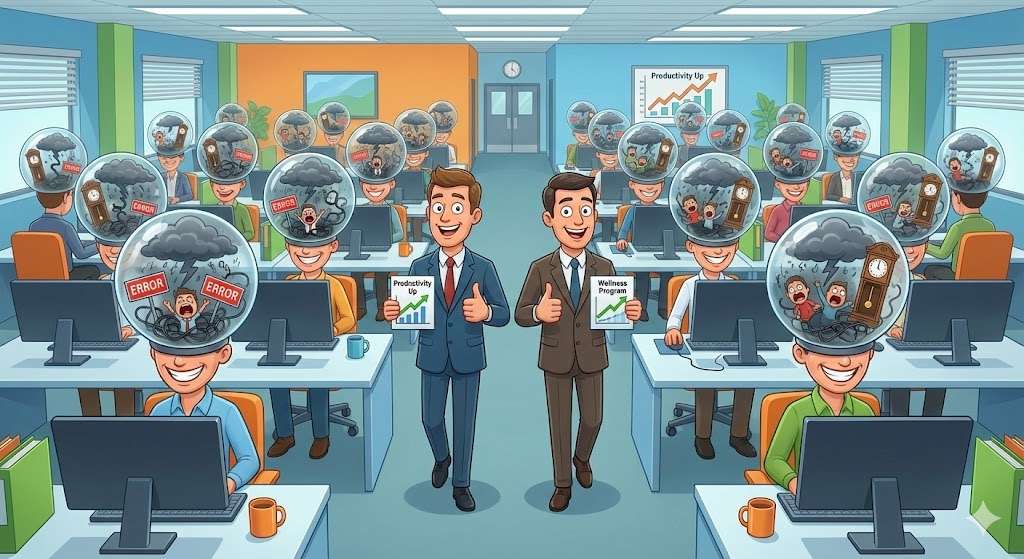
The Office Is Quiet, But Everyone Is Screaming Inside

Around one in seven adults of working age was living with a mental health condition as of 2019.
Depression and anxiety together lead to the loss of roughly 12 billion workdays worldwide each year, costing the global economy about one trillion dollars in lost productivity.
Workplace Mental Health Crisis No One Talks About
Nobody talks about it openly, but almost everyone feels it.
The tight chest before logging into Slack.
The fake smile during meetings.
The Sunday night anxiety that ruins the weekend.
Workplace mental health issues are no longer a “soft topic.” They are the invisible epidemic sitting behind KPIs, deadlines, and performance reviews.
And the worst part?
Most offices still pretend everything is fine.

The Modern Workplace Is Mentally Exhausting by Design
Let’s be honest. Today’s workplace is not built for mental well-being. It is built for output.
Always-on culture.
Endless notifications.
Blurred lines between work and life.
“Urgent” emails at 11:47 PM.
You are expected to perform like a machine but feel emotions like a human. That contradiction breaks people quietly.
Earlier, work stress ended when you left the office. Now the office lives in your pocket. Your phone vibrates, and your body reacts before your brain does.
That is not productivity. That is conditioning.
Burnout Is Not Laziness, It’s System Failure
Burnout gets labeled as weakness far too often.
“He can’t handle pressure.”
“She’s not resilient enough.”
“They lack grit.”
No. Burnout happens when effort and reward stop making sense.
When people give more and more but receive less control, less appreciation, and less meaning. When every task feels urgent but nothing feels important. When hard work no longer guarantees growth, stability, or respect.
Burnout is not about working hard. It is about working without hope.
Anxiety Has Become the Office Background Noise
In many workplaces, anxiety is normalized.
Fear of missing deadlines.
Fear of layoffs.
Fear of being replaced by AI.
Fear of saying the wrong thing.
Fear of being “visible” but not valued.
People attend meetings while silently calculating risks. One wrong move, one bad quarter, one manager’s mood swing, and everything feels fragile.
This constant state of alert drains the nervous system. People stop thinking clearly. Creativity dies. Confidence erodes.
Yet we still call it “fast-paced culture.”
Depression Wears a Professional Mask
Depression at work does not look like crying at a desk.
It looks like high performers slowly disengaging.
It looks like people doing the bare minimum to survive.
It looks like talent fading without explanation.
Many employees show up every day while feeling empty inside. They deliver work, attend meetings, reply politely, and go home feeling nothing.
And because they are “functioning,” nobody notices. Including HR.
Toxic Positivity Makes It Worse
One of the most damaging workplace trends is forced positivity.
“Be grateful you have a job.”
“Others have it worse.”
“Let’s stay positive.”
This shuts people up. It tells them their pain is inconvenient.
Mental health does not improve by pretending everything is okay. It improves when people feel safe enough to say it is not.
A culture that only accepts smiles is not healthy. It is performative.
Managers Are Often the Biggest Trigger
This is uncomfortable to say, but true.
Most workplace mental health damage does not come from workload. It comes from leadership.
- Unclear expectations.
- Public shaming disguised as feedback.
- Micromanagement.
- Silent treatment.
- Favoritism.
- Mood-driven decisions.
People don’t quit companies. They mentally shut down under bad managers long before they physically leave.
And no meditation app can fix a toxic boss.
HR Policies Are Not Enough
Many companies now talk about mental health. They offer wellness webinars, yoga sessions, and counseling hotlines.
But let’s be real.
You cannot meditate your way out of a toxic culture.
You cannot “self-care” away unrealistic expectations.
You cannot heal while the same system keeps hurting you.
Mental health support without structural change is just PR.
Remote Work Helped, Then Created New Problems
Remote work reduced some stress, but introduced new ones.
- Loneliness.
- Isolation.
- Always-online pressure.
- Blurred work hours.
Some people now feel invisible instead of overwhelmed. Others feel like they must overperform to prove they are working.
Mental health is not fixed by location. It is shaped by culture.
What Actually Helps, But Rarely Happens
Real improvement requires uncomfortable changes.
Leaders who listen without defending.
Workloads that reflect reality, not optimism.
Clear boundaries around time.
Psychological safety to speak honestly.
Managers trained in empathy, not just execution.
Most importantly, respect for human limits.
People are not infinite resources.
The Silent Cost Businesses Ignore
Mental health issues don’t just hurt individuals. They quietly drain organizations.
- Lower productivity.
- Higher turnover.
- Poor decision-making.
- Loss of creativity.
- Erosion of trust.
Companies pay for burnout whether they acknowledge it or not. They just pay later, and more.
The Truth Nobody Wants to Say
Work should not make people mentally sick to be considered successful.
Stress is not a badge of honor.
Overwork is not ambition.
Silence is not strength.
A healthy workplace is not one where nobody struggles. It is one where struggle is not punished.
Until organizations stop treating mental health as an individual problem instead of a systemic one, nothing truly changes.
And until then, many offices will remain quiet places full of people screaming inside.

