

- 23 December 2025
- No Comment
- 208
The Hidden Wins of AI: Reducing Waste in Traditional Businesses

When we talk about Artificial Intelligence, the conversation usually drifts toward the flashy stuff: Chatbots that write poetry, image generators that create surreal art, or humanoid robots doing backflips.
But while the tech world obsesses over the “next big thing,” a quiet revolution is happening in the places we rarely look: dusty cement factories, freezing cold storage trucks, and the back offices of grocery stores.
This is the world of Traditional Business AI, specifically Predictive Analytics. It isn’t sexy. It doesn’t make headlines. But it is saving billions of dollars by solving boring, invisible problems that have plagued industries for decades.
For manufacturers, retailers, and logistics companies, the goal isn’t to replace humans with robots; it’s to replace guessing with knowing.
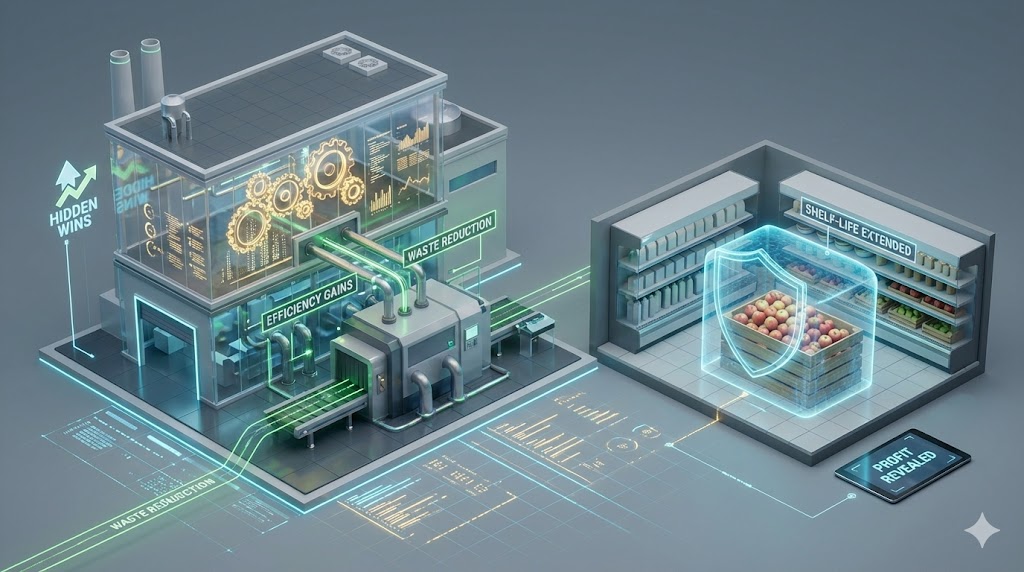
Here are the hidden wins of predictive analytics that nobody talks about, but everyone is profiting from.
1. Manufacturing: The War on “Invisible” Waste
In manufacturing, margins are razor-thin. A fraction of a percent in efficiency can mean the difference between profit and loss. Traditionally, factories operated on a “break-fix” model: run the machine until it smokes, then fix it. Or, they operated on “gut feel” quality control: the veteran shift manager knows the mix is right because it “looks right.”
Predictive analytics has turned these old habits upside down.
The “Goldilocks” Problem: Paper and Textiles
Making paper or dyeing fabric is surprisingly difficult. It’s a “Goldilocks” problem: the product can’t be too wet, can’t be too dry, and the color has to be exactly right.
In the paper industry, “moisture control” is a massive energy drain. If the paper is too wet, it rots; too dry, it becomes brittle and wastes steam energy to over-dry it. Traditionally, operators waited for lab results to adjust the steam, by which time miles of paper had already been produced.
-
The Hidden Win: A case study from JK Paper shows how AI models now predict moisture levels in real-time based on input variables. By adjusting steam usage before the paper is dried, they reduced steam consumption and stabilized quality without manual intervention.
Similarly, in textiles, dyeing fabric is a gamble. Wet fabric looks different than dry fabric. Manufacturers often have to dry a swatch to check the color, which wastes time and energy.
-
The Hidden Win: Researchers and companies like Welspun have implemented computer vision and ML models that predict the final dry color of a fabric while it is still wet. This “predictive quality control” reduced raw material wastage by 15% and post-production defect complaints by 30%.
The Energy Leech: Cement Manufacturing
Cement plants are energy beasts. They consume massive amounts of electricity to grind raw materials. Often, a specific machine part, like a classifier in a mill-will degrade slightly, causing the mill to consume 15-20% more power to do the same job. This degradation is invisible to the human eye until the machine breaks.
-
The Real-World Example: A cement plant in Southeast Asia used predictive asset intelligence to monitor power consumption patterns. The AI flagged that “Cement Mill #2” was consuming 16% more power than its twin due to a hidden inefficiency. Fixing this single issue saved the plant $340,000 annually. In total, the plant saved $3.2 million in energy costs in one year simply by listening to the data.
2. Logistics: Ending the Era of “Ghost Trucks” and Melted Cargo
Logistics is the circulatory system of the global economy. But it suffers from two massive inefficiencies: driving empty trucks (hauling air) and spoiled goods (broken fridges).
The “Ghost Truck” Problem (Empty Miles)
Imagine paying for a taxi to drive you to the airport, and then the taxi driver drives all the way back to the city with no passenger. That is an “empty mile.” In trucking, it’s a disaster. About 15-30% of all truck miles are driven empty, burning fuel and money for zero revenue.
-
The Hidden Win: Philip Morris International (PMI) in Türkiye faced this issue with trucks delivering goods to 81 destinations and returning empty. They used predictive logistics platforms to identify “backhaul” opportunities, finding other companies that needed goods moved on the return route.
-
The Result: They turned a cost center into a revenue stream, reducing their carbon footprint and generating income from what used to be waste.
The “Melting Ice Cream” Problem (Cold Chain Failure)
Shipping vaccines, strawberries, or frozen fish requires “reefer” (refrigerated) containers. If a reefer breaks down in the middle of the ocean, the cargo is lost. Traditionally, you wouldn’t know it broke until the ship arrived at the port and you opened the door to a smell of rotting food.
-
The Hidden Win: Companies like Maersk and tech providers like Eelink now use IoT sensors coupled with predictive analytics. The system learns the “heartbeat” of a compressor. If the motor starts vibrating abnormally or the temperature fluctuates slightly, the AI predicts a failure days before it happens. Maintenance crews can fix the reefer at the next port stop, saving millions in insurance claims and wasted food.
3. Retail: The Crystal Ball for Freshness and Theft
Retailers are fighting two wars: one against spoilage (food going bad) and one against “shrink” (theft and fraud).
The “Rotting Berry” Problem
Supermarkets operate on thin margins. Fresh produce is the hardest category to manage because strawberries don’t care about your spreadsheet; they rot when they want to. Store managers historically ordered produce based on intuition (“I feel like we’ll sell more bananas this week”). They were often wrong, leading to massive food waste.
-
The Hidden Win: Startups like Afresh and Shelf Engine brought predictive analytics to the produce aisle. By analyzing historical sales, local weather, and even holidays, these tools tell managers exactly how many boxes of avocados to order.
-
The Result: Pilot programs have shown food waste reductions of 30% or more in fresh departments. This isn’t just good for the planet; it’s pure profit for the grocer.
The “Warranty Cheat” Problem
Fraud is a massive drain on electronics and automotive manufacturers. “Warranty fraud” happens when service centers claim to have fixed parts they didn’t break, or customers return items that aren’t actually defective.
-
The Hidden Win: Detecting this manually is impossible, there are too many claims. But AI excels here. By analyzing millions of claims, predictive models can spot anomalies. For example, if one specific repair shop in Ohio claims 500% more “battery failures” than the national average, the AI flags it for investigation. Automotive OEMs are now using these tools to save millions in false payouts, identifying fraud rings that operated unnoticed for years.
4. The Human Element: Staffing Without the Burnout
Predictive analytics isn’t just about machines; it’s about people. One of the hardest tasks for any manager in fast food or retail is the schedule. Schedule too few people, and customers get angry. Schedule too many, and you burn cash.
-
The Hidden Win: Maestro Pizza in Saudi Arabia used simulation and predictive modeling to solve this. Instead of a manager guessing how many drivers they needed for Friday night, the AI analyzed traffic patterns, order history, and cooking times.
-
The Result: They optimized their “rush hour” staffing, ensuring drivers were available exactly when demand spiked, reducing delivery times and cutting unnecessary overtime costs.
Boring is Profitable
The common thread across these stories is that none of them sound like science fiction. There are no holograms or sentient robots.
It is simply a cement mill knowing it is sick before it breaks. It is a truck finding a package to carry on its way home. It is a supermarket manager knowing that it’s going to rain on Tuesday, so nobody will buy watermelon.
For traditional businesses, the “hidden win” isn’t about inventing the future. It’s about using data to stop wasting the present. While the tech giants fight over who has the smartest Chatbot, traditional industries are quietly using predictive analytics to become leaner, faster, and significantly more profitable.