


- 18 February 2026
- No Comment
- 118
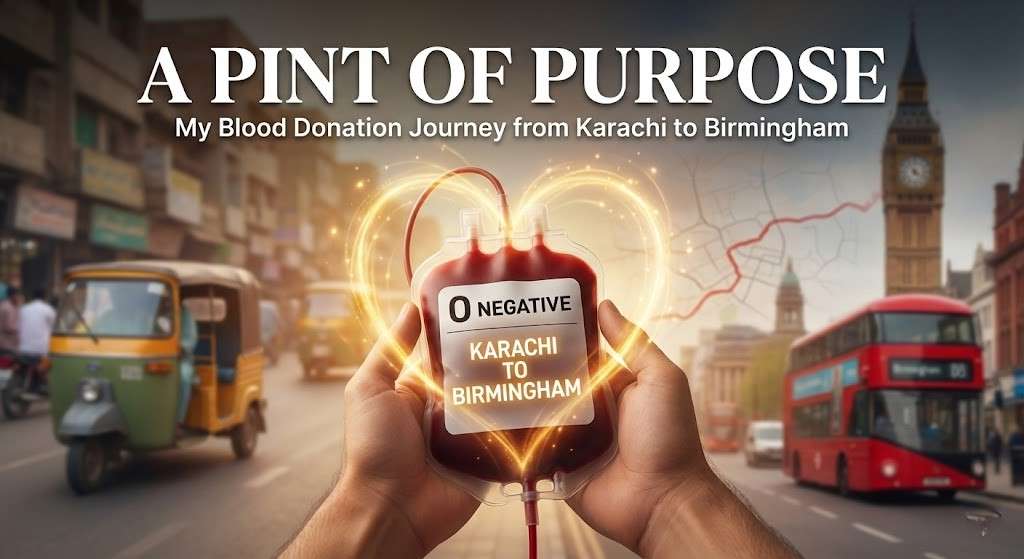
A Pint of Purpose: My Blood Donation Journey from Karachi to Birmingham

Author: Altamash Siddiqui
Reading Time: 3 min read
There’s something I’ve always found fascinating about donating blood. Maybe it’s the idea that something so simple, just sitting still for 15 minutes, can literally save someone’s life. Or maybe it’s the curiosity I’ve always had about my own blood group. Either way, blood donation has been on my radar for as long as I can remember.
My first experience was back in 2012 at a blood drive organised by the Fatimid Foundation at the University of Karachi. I was younger, slightly nervous, but mostly excited. That was the day I found out my blood group is O negative. If you know anything about blood types, you’ll know that O negative is one of the rarest types and is considered the universal donor. That basically means my blood can be given to almost anyone in an emergency.
I remember feeling a strange sense of responsibility that day. Out of all the blood types I could’ve had, I ended up with one that’s in high demand. From that point on, I genuinely felt it was my moral duty to give something back to humanity whenever I could.
After that first donation, I donated again at a government hospital in Karachi. Let’s just say… it wasn’t the best experience. It was disorganised, uncomfortable, and left me questioning whether I’d want to go through that again. But that’s a story for another time.
Fast forward a few years—I moved to Birmingham, UK, for my studies. Being in a new country didn’t change that sense of responsibility I felt. If anything, it strengthened it. So I registered with the NHS Blood and Transplant programme and booked my appointment for the summer of 2024 at the blood donation centre on New Street in Birmingham.
From the moment I walked in, I could tell this experience would be different. The nursing staff were incredibly professional and welcoming. There was no chaos, no confusion—just a calm, organised environment. They handed me a few forms to fill out, mostly about previous illnesses, recurring medical issues, and general health screening questions. It was thorough but straightforward.
Once I’d completed the paperwork, they asked me to have some squash juice from the waiting area. Everything was neatly arranged—drinks lined up, chairs placed comfortably, and a relaxed atmosphere. I had a glass and tried to steady my nerves.
When my name was called, I went over and lay down on one of the long reclining chairs. The nurse handed me a pamphlet explaining what to do during the donation—things like gently clenching and unclenching my fists, wrapping and unwrapping my wrists, and tightening and relaxing my hip muscles to keep circulation steady.
Even though I’d done this before, I won’t lie—I felt nervous. There’s always that split second when they prepare the needle that makes you question your life choices. But honestly, the process itself was incredibly smooth. The needle went in with minimal discomfort, and within about 15 minutes, it was done.
Or so I thought.
As I got up shortly afterwards, I suddenly felt lightheaded. The room started spinning, and before I knew it, I had collapsed onto the floor. It was one of those surreal moments where your body just gives up before your mind fully processes what’s happening.
The nurses reacted instantly. They lifted me onto another bed, placed a cooling pad around my neck, and monitored me closely. Apparently, I had overheated and my blood pressure had dipped after the donation. Within minutes, I started feeling better. A bit embarrassed? Definitely. But also incredibly grateful for how quickly and professionally they handled it.
Once I recovered, I happily accepted the donor snacks—biscuits, more juice, and a chance to sit and reflect on what had just happened.
The most rewarding part came later. A few days after my donation, I received a text message telling me which hospital my blood had been sent to. Shortly after, I got an email describing the journey my blood went through—how it was tested, processed, separated, and then delivered to help a patient in need. That message made everything worth it.
Despite the wobble at the end, donating blood in Birmingham was an experience I’m proud of. It reminded me that giving blood isn’t just good for your own health—it encourages your body to replenish and renew—but more importantly, it’s good for humanity. A small act from you can mean a second chance at life for someone else.
And for me, being O negative, that responsibility feels even more personal.
E Blood
Just as I found my purpose in donating, you can make an immediate impact right here in Pakistan. E Blood is revolutionising the landscape as the country’s first AI-powered blood donation app.
By utilising smart, location-based technology, it instantly connects donors with patients in critical need, making the process faster, safer, and more accessible. With a vision to ensure that no life is ever lost due to a lack of blood, E Blood is building a powerful digital network driven by community and compassion.
Save lives with a single tap. Join the movement and download the app today at: eblood.com.pk