

- 9 April 2026
- No Comment
- 350
How a Tiny Waterway Broke the World
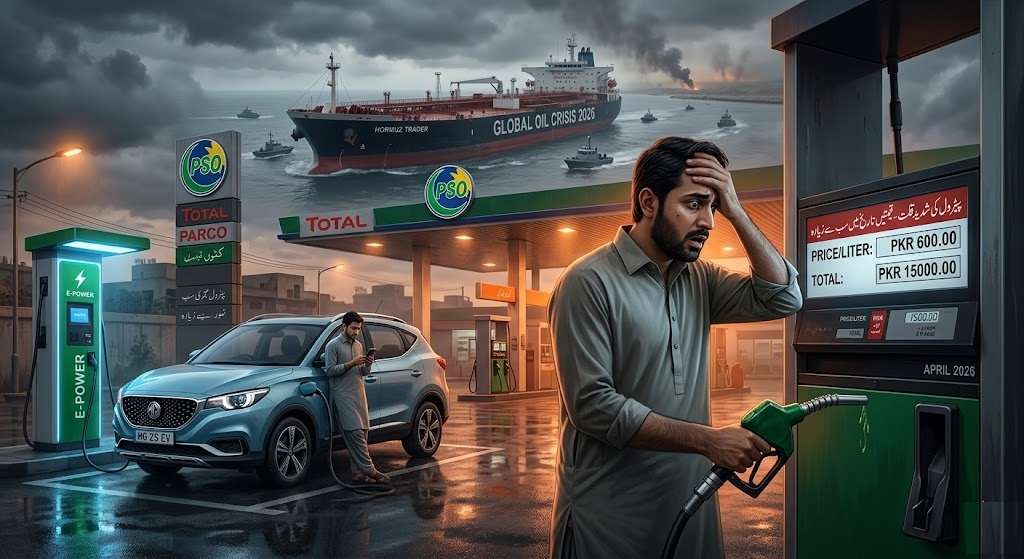

Imagine a narrow stretch of water, barely 21 miles wide at its narrowest point. Now imagine that 20% of the world’s daily oil supply and a fifth of its liquefied natural gas, is suddenly trapped behind it.
In late February and early March 2026, this nightmare scenario became a reality. Following unprecedented military conflict in the Middle East, the Strait of Hormuz was effectively blocked. Almost overnight, the global economy was plunged into the most violent energy shock in modern history.
Brent crude oil, the global price benchmark, rocketed from the mid-$60s to a staggering peak of over $126 a barrel. It marked the biggest monthly price surge on record, beating even the spikes seen during the 1990 Gulf War. But this isn’t just a story about numbers on a Wall Street screen. This is a story about how a geopolitical chokepoint is fundamentally altering the cost of living for every human being on the planet.
The Geopolitical Chokepoint: Why the Strait of Hormuz Matters
When oil stops flowing, the pain is felt universally, though each nation experiences its own unique brand of chaos. The true driver of this crisis isn’t just the gasoline in everyday cars; it’s the surging cost of diesel, the lifeblood of global trade.
Perhaps the most terrifying ripple effect is happening in the grocery aisle. Modern agriculture is essentially the process of converting fossil fuels into food. Not only are tractors vastly more expensive to run, but the Middle East also exports massive amounts of urea and ammonia, the foundational ingredients for global fertilizer. With these chemicals trapped, fertilizer prices are spiking, guaranteeing a severe global food price crisis in the coming months.
A World Running on Empty: The Global Impact
To understand why oil prices effectively doubled in a matter of weeks, one must understand maritime geography and the mechanics of the global supply chain. The Strait of Hormuz is a narrow passage between the Persian Gulf and the Gulf of Oman. Under normal circumstances, approximately 20 to 21 million barrels of crude oil and petroleum products pass through this strait every single day.
When the United States and Israel launched military operations against Iran in late February 2026, the Iranian military retaliated by leveraging its geographic advantage. Utilizing a combination of naval mines and inexpensive, asymmetric drone warfare, Iran transformed the Strait of Hormuz from a bustling global shipping lane into a highly restricted, militarized no-go zone. Within days, maritime insurance companies either refused to underwrite vessels entering the region or hiked their premiums from a nominal 0.5% to a punishing 5% or more of a ship’s total value. The number of commercial ships daring to cross the strait plummeted from a daily average of 135 to a mere 10.
The Trapped “Relief Valve” of the Oil Market
During previous oil disruptions, such as a hurricane knocking out refineries in the Gulf of Mexico or localized sanctions on a single nation, the global market relies on a built-in safety mechanism known as “spare capacity”. Spare capacity acts as the world’s economic shock absorber. It consists of oil wells that can be quickly turned on to flood the market with millions of extra barrels of oil, driving prices back down.
Historically, this spare capacity has been held almost entirely by Gulf Coast nations, primarily Saudi Arabia, the United Arab Emirates (UAE), Kuwait, and Iraq. At the end of 2025, these nations held roughly 4 million barrels per day of excess production capability.
However, the March 2026 crisis presented a unique and catastrophic geographic dilemma. This 4 million barrel-per-day “relief valve” is physically located inside the Persian Gulf, trapped behind the Iranian blockade. Even if Saudi Arabia and Iraq pumped oil at maximum capacity, they had no way to physically sail the crude out of the region to the global market. The situation became so dire that by early March, Iraq was forced to shut down operations at its massive Rumaila oil field simply because it ran out of storage tanks to hold the oil that could not be exported.
The closure of the strait effectively severed the long-standing “oil for security” bargain that had defined U.S.-Gulf relations since 1945, leaving the global market completely exposed to violent price spikes without any immediate physical mechanism for relief.
To grasp the severity of this bottleneck, one must compare the Strait of Hormuz to other global transit routes and observe the sheer impossibility of easily rerouting this volume of trade.
|
Global Transit Chokepoint |
Daily Oil Flow (% of Global Trade) | Alternative Routing Option |
Added Transit Time Penalty |
| Strait of Hormuz |
21.0% |
Around Africa (Cape of Good Hope) | +15 to +20 days |
| Strait of Malacca |
16.0% |
Lombok/Makassar Straits |
+3 to +5 days |
| Suez Canal |
5.5% |
Around the Cape of Good Hope | +10 to +15 days |
“Risk Premiums” and “Coiled Springs”
The “Risk Premium” (The Fear Tax) Experts keep saying oil prices are high because of a “risk premium”. Think of this as a global “fear tax.” Airlines, shipping companies, and governments are terrified of what might happen tomorrow. Will the strait stay closed for weeks? Months? To protect themselves, they are willing to pay way over the actual physical value of the oil today just to guarantee they don’t run out tomorrow. This panic insurance is keeping prices artificially sky-high.
The “Symmetrical Triangle” (The Coiled Spring) On platforms like X, day traders are obsessing over charts showing a “symmetrical triangle breakout”. Imagine compressing a heavy metal spring between your hands. The market is in a fierce tug-of-war between buyers and sellers, squeezing the price tighter and tighter. The price is testing “resistance”, a psychological ceiling where people normally sell. Traders know the spring can’t stay compressed forever. When breaking news hits, the spring pops, and the price will violently explode past that resistance level, likely sending fuel costs even higher.
The Return of the “S-Word”: Stagflation
The most frightening word in economics has officially returned to the global vocabulary: Stagflation.
Stagflation is an economic nightmare that combines three terrible conditions at the exact same time:
- High Inflation: Prices for food, energy, and goods keep rising.
- Stagnant Growth: The economy slows to a crawl because businesses can’t afford to operate.
- Rising Unemployment: Companies are forced to lay off workers to survive.
It is the worst of both worlds. People are making less money, yet everything they need to survive costs drastically more. Central banks are paralyzed; if they raise interest rates to fight high prices, they might cause more job losses. If they lower rates to save jobs, prices might spiral further out of control.
The Silver Lining: An Electric Tipping Point
If there is one glimmer of hope in this historic crisis, it is how rapidly the world is adapting. Severe energy shocks often force humanity to innovate, and the March 2026 crisis is serving as the ultimate catalyst to end our reliance on fossil fuels.
With oil hovering near $120 a barrel, the math of owning a car has permanently changed. In massive, developing markets like India, the contrast is impossible to ignore:
|
Vehicle Type |
Running Cost (Per Kilometre) |
| Traditional Petrol Car |
7 to 10 INR |
|
Electric Vehicle (EV) |
0.8 to 1.5 INR |
When an electric car becomes up to 10 times cheaper to drive than a gas-powered car, consumer hesitation vanishes. Global shoppers are aggressively abandoning traditional engines. Chinese EV manufacturers, who offer highly affordable battery-powered cars, and Japanese automakers like Toyota, who dominate the hybrid market, are seeing massive surges in global demand.
A Changed World
The March 2026 oil shock proves that relying on volatile, easily blocked maritime chokepoints is a recipe for global economic disaster. While the immediate months ahead will be defined by painful grocery bills, high shipping costs, and the looming threat of stagflation, the long-term picture is clear.
The world is realizing that true economic security doesn’t come from a barrel of oil shipped across a dangerous ocean. It comes from sunshine, wind, and batteries. The faster we make that transition, the sooner we ensure that a single blocked strait can never hold the global economy hostage again.