
- 16 March 2026
- No Comment
- 490
Your AI Chatbot Is Drinking Your Neighbor’s Water

The Invisible Water Cost of AI
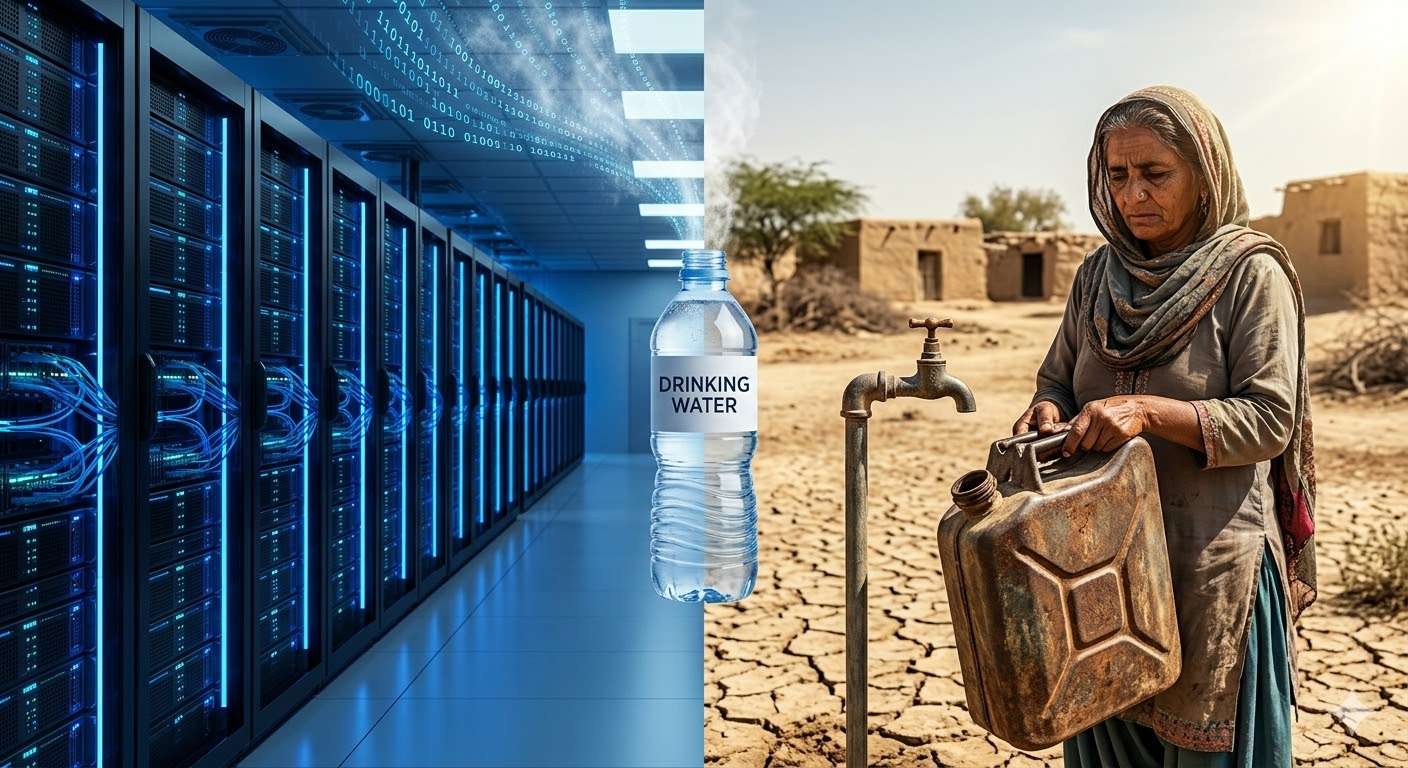
When you ask an AI chatbot to write a poem or help with your homework, it feels like magic, an invisible force responding from a digital “cloud.” But for Sandra García, a 38-year-old factory worker in Colón, Mexico, that cloud has a very physical, very thirsty presence.
Sandra often turns her kitchen tap only to find it bone-dry. In her region, where 17 out of 18 municipalities are gripped by drought, she must trek to her landlord’s house to fill jerry cans just to have enough water for her family to survive. While she watches the sky for rain, a few miles away, massive data centers belonging to global tech giants are moving in, requiring millions of liters of water to keep their humming server racks from overheating.
This is the hidden cost of the AI revolution: a global competition for the world’s most precious liquid.
Every time you have a conversation with an AI (roughly 10 to 50 questions), you are effectively “drinking” a 500ml bottle of fresh water through the cooling system of a distant server.
Infrastructure and Municipal Water Security
The rapid proliferation of generative artificial intelligence (AI) and the hyperscale infrastructure required to support it have introduced a critical new competitor for the world’s most essential resource: freshwater. As data centers migrate from the periphery of industrial zones into the heart of municipal watersheds, the physical manifestation of “the cloud” has shifted from an abstract digital concept to a tangible hydrological burden. In communities from West Des Moines to Santiago, and from the semi-arid regions of central Mexico to the green belts of the United Kingdom, the arrival of massive computing facilities has coincided with a phenomenon that once seemed impossible in the age of advanced infrastructure: residential taps running dry while server racks remain cool.
This article examines the intricate relationship between high-performance computing and water security, detailing the technical mechanisms of consumption, the socio-political flashpoints of community resistance, and the emerging regulatory frameworks attempting to govern this new frontier.
The Thermodynamics of Intelligence: Mechanisms of Water Consumption
The fundamental requirement for water in the data center industry is a direct consequence of the laws of thermodynamics. High-performance Graphics Processing Units (GPUs) and Tensor Processing Units (TPUs), which power the training and inference of large language models, generate intense heat as a byproduct of their computational work. To prevent hardware failure and maintain operational efficiency, this heat must be rejected into the environment. Historically, data centers have relied on water as the “thermodynamic currency” due to its high heat capacity and low cost compared to real estate or electricity.
The cooling process typically involves circulating water through heat exchangers or using evaporative cooling towers. In an evaporative system, heat is removed by allowing a portion of the water to evaporate, which dissipates thermal energy into the atmosphere. This process requires a constant supply of “make-up water” to replace what is lost to evaporation. For a typical 100 megawatt (MW) data center, this demand can reach 2 million liters of water per day, a volume sufficient to support a town of tens of thousands of residents.
The water footprint of AI is generally categorized into three distinct scopes, mirroring carbon accounting frameworks. These categories represent a comprehensive view of how digital activity translates into hydrological depletion.
Categorization of AI Water Footprints
|
Water Footprint Category |
Definition and Scope |
Primary Mechanism of Loss |
| Scope 1 (Direct) | On-site consumption at the facility. | Evaporative cooling, humidification, and adiabatic systems. |
| Scope 2 (Indirect) | Off-site consumption at the power plant. | Cooling for fossil-fuel, nuclear, or hydroelectric plants providing grid power. |
| Scope 3 (Supply Chain) | Embedded water from manufacturing. | Ultrapure water used in semiconductor fabrication and mining of hardware materials. |
Research indicates that indirect water use (Scope 2) can be up to four times higher than direct on-site consumption, creating a hidden hydrological cost that is often omitted from corporate sustainability reports. This “energy-water nexus” means that even if a facility claims to be “air-cooled” on-site, its demand for grid power may still trigger massive water withdrawals at a distant power plant. Furthermore, the production of the very chips that populate these centers is an intensely thirsty process. Creating ultrapure water (UPW) requires approximately 1,500 gallons of piped water to produce 1,000 gallons of UPW, and a single chip manufacturing facility can consume up to 10 million gallons of UPW per day.
Measuring Efficiency: The Water Usage Effectiveness (WUE) Metric
The industry standard for quantifying water efficiency is the Water Usage Effectiveness (WUE) metric. It is expressed as the ratio of annual site water consumption to the energy used by the IT equipment.
WUE=IT Equipment Energy (kWh)Annual Site Water Consumption (Liters)
While the industry average for WUE typically hovers around 1.8 to 1.9 L/kWh, hyperscale facilities optimized for AI workloads often achieve lower ratios through advanced engineering, though these values vary widely by local climate. However, even as WUE improves, the total volume of water consumed continues to rise due to the sheer expansion of the sector. As chip densities increase, from an average of 36 kW per rack in 2023 to an expected 50 kW by 2027, the volume of water required to maintain stable temperatures is likely to rise regardless of marginal efficiency gains.
The Geography of Conflict
The tension between digital expansion and water security has reached a breaking point in several key geographical regions. These “water wars” often follow a predictable pattern: a technology giant announces a multi-billion dollar investment promising jobs and tax revenue, only for residents to discover that the facility’s water demand rivals that of their entire municipality.
- Uruguay: In 2023, the country faced its worst drought in 74 years. Residents were forced to drink salty, brackish water from their taps because freshwater reservoirs were empty. At the same time, a proposed data center was set to use 7.6 million liters of potable water a day, enough for a town of 55,000 people.
- The American Heartland: In West Des Moines, Iowa, Microsoft used 11.5 million gallons of water in a single month to cool the supercomputers that trained the famous GPT-4 model. That represented 6% of the entire district’s water usage, prompting the local utility to warn the tech giant that future expansions might be blocked to save water for residents.
- The United Kingdom: In East London, residents have organized a “March Against The Machines” to protest massive “resource-hungry” data centers planned for the Green Belt. Critics recently alleged that a proposed project in the UK understated its planned water usage by a factor of 50, fueling a growing “international backlash”.
Comparative Water Consumption of Tech Giants (2023)
|
Company |
Global Water Consumption (Gallons) |
Percentage Used by Data Centers |
Key Concentration Area |
|
6.4 Billion |
95% | Council Bluffs, Iowa. | |
| Microsoft |
1.7 Billion |
Not specified (aggregate) | West Des Moines, Iowa. |
|
Meta |
813 Million |
95% | US-wide facilities. |
Europe: Scrutiny and Scandal in the Netherlands and UK
In the Netherlands, a Meta project in Zeewolde was halted after local and environmentalist objections regarding groundwater consumption. A separate scandal involved a Microsoft facility in North Holland that consumed 84 million liters of water in a single year, four times the 20 million liters initially promised, during a heatwave when residents were under water, use advisories.
The United Kingdom has seen a similar rise in tension. In Havering, East London, plans for a “resource-hungry” mega-campus on semi-rural Green Belt land have faced significant opposition. Residents and groups like Friends of the Earth Havering cite the vast amount of water needed for cooling in an area where supplies are “already challenged”. In Buckinghamshire, the government was forced to admit a “serious logical error” in approving the Woodlands Park data center without sufficient environmental protections, leading to a legal U-turn. Activists have even organized a “March Against The Machines” outside OpenAI’s offices to protest the impact of these facilities on communities.
The Scale of the Thirst: Data Projections for 2027-2030
The aggregate water demand of the AI industry is projected to undergo exponential growth. While individual queries, such as asking ChatGPT a series of 10 to 50 questions, may only consume roughly 500 ml of water (equivalent to one standard bottle), the scale of millions of users performing these actions daily creates a massive cumulative footprint.
Global AI demand by 2027 is estimated to account for 4.2 to 6.6 billion cubic meters of water withdrawal annually. To contextualize this volume, it surpasses the total annual water withdrawal of nations like Denmark or half of the United Kingdom. Some projections suggest that by 2030, the global data center industry will consume over 1.2 trillion liters of water each year.
Projected Growth in AI Water and Energy Demands
|
Metric |
2020-2023 Baseline | 2027-2030 Projection |
Key Driver |
| Global Water Withdrawal |
~560 Billion Liters (2023) |
1.2+ Trillion Liters (2030) |
Generative AI Inference. |
| US Electricity Share |
4.4% (2023) |
6.7% – 12.0% (2028) |
Hyperscale Expansion. |
| AI Carbon Emissions |
Baseline growth |
24 – 44 Million Metric Tons (2030) |
Data center boom. |
Infrastructure Fragility and the Case of Pakistan
The conflict between data center expansion and water security is particularly acute in the Global South, where infrastructure is often already fragile. In Pakistan, the fifth most populous country in the world, the government is pushing for digital transformation and the construction of AI-ready data centers in Karachi. However, this push occurs against a backdrop of “absolute water scarcity,” with per capita water availability having plummeted from 5,600 cubic meters in 1947 to just 930 cubic meters in 2023, well below the threshold for scarcity.
Karachi, a megacity of over 20 million residents, requires approximately 1.1 billion gallons of water daily, yet only receives about half of that amount. The existing water distribution network is plagued by “non-revenue water” losses, with 35% to 40% of piped water wasted through leakages and theft. Furthermore, climate change is amplifying this stress, making dry seasons drier and wet seasons wetter, the catastrophic floods of 2022 alone caused $30 billion in losses and contaminated freshwater supplies.
In such an environment, the introduction of hyperscale data centers, which could require millions of liters of water per day, threatens to exacerbate existing “water-driven shocks” that already undermine the city’s health and economic stability. Heatwaves in 2024 saw temperatures in Karachi and Hyderabad surpass 52°C, leading to thousands of heatstroke admissions in hospitals that were already struggling with power outages. The fragility of the digital backbone was further exposed in August 2025, when a single storm caused connectivity levels to crash to one-fifth of normal nationwide. The reliance on a centralized infrastructure that is vulnerable to both floods and water shortages highlights the extreme risks of building massive digital hubs in regions where basic utility resilience is not yet secured.
The Transparency Crisis and Proprietary Data
A recurring theme in the struggle over data center water use is the lack of transparency. Many technology companies treat their specific water consumption data as proprietary “trade secrets,” preventing local authorities and citizens from assessing the true impact on local aquifers. In some instances, municipal utilities have declined to release customer-specific data, leaving communities “in the dark” about how much of their shared resource is being diverted to cool servers.
In Racine, Wisconsin, an environmental group was forced to sue the city to release documents describing the estimated water usage of a proposed Microsoft data center. The eventual disclosure revealed a projected usage of 8.4 million gallons per year, a figure that had been shielded from public view during the initial permitting process. This lack of transparency leads to “broken promises,” as seen in the Netherlands, where Microsoft was criticized for using four times more water than initially disclosed during a heatwave.
The lack of consistent reporting standards makes “apples-to-apples” comparisons difficult. While some companies report global aggregate consumption, they often fail to disclose site-specific data for facilities in high-water-stress areas. This opacity has led to calls for mandatory, location-specific reporting and independent environmental audits to ensure compliance with sustainability pledges.
Technical Mitigation: Moving Beyond Evaporation
The industry is currently at a “fork in the road” regarding cooling technology. While traditional evaporative cooling is the cheapest and most common method, the rising cost of water and increasing regulatory pressure are driving interest in more sustainable alternatives.
Liquid Cooling Technologies and Lifecycle Assessments
Advanced liquid cooling methods offer the potential to significantly reduce the water footprint of data centers by moving heat more efficiently than air. These technologies include:
- Cold Plates (Direct-to-Chip): Liquid is pumped through microchannels directly on the chip’s surface to absorb heat. This method typically operates in a “closed-loop” system, requiring minimal “make-up” water.
- Immersion Cooling: Servers are completely submerged in a bath of non-conductive dielectric fluid (such as synthetic oil or specially engineered liquids) that absorbs heat directly from the components.
- Two-Phase Waterless Cooling: An innovative approach using fluids that boil and condense, allowing for superior heat dissipation without the use of water.
A lifecycle assessment (LCA) published in Nature by Microsoft researchers quantified the environmental costs of these technologies from “cradle to grave,” including raw material extraction and component manufacturing. The study found that switching from standard air cooling to liquid-based cold plates can reduce energy demand and greenhouse gas emissions by roughly 15% and water consumption by 30% to 50%. However, immersion cooling technologies currently rely on polyfluoroalkyl substances (PFAS), which are under regulatory scrutiny due to their persistence in the environment.
Technical Comparison of Data Center Cooling Methods
|
Method |
Water Requirement | Energy Requirement |
Primary Constraint |
| Evaporative Cooling |
High (Direct Loss) |
Low |
High municipal water demand. |
| Free Air Cooling |
Minimal |
High (Fans) |
Climate-dependent; risk of overcooling. |
| Closed-Loop Liquid |
Near Zero |
Moderate |
High capital cost; complex retrofits. |
| Two-Phase Waterless |
Zero |
Moderate to Low |
PFAS regulatory risks; technological maturity. |
The Trade-off: Water vs. Energy
A critical challenge in data center design is the inverse relationship between water and energy efficiency. Air-cooled systems, which save water by using massive fans to move heat, typically require more electricity than water-intensive evaporative systems. In regions where the electricity grid is powered by fossil fuels, saving water on-site may lead to higher carbon emissions and higher indirect water consumption at the power plant. Policies must therefore support balanced decision-making rather than focusing solely on a single environmental metric.
Regulatory Responses and the Public Trust Doctrine
As community pushback intensifies, state and national governments are beginning to implement stricter oversight. Several U.S. states are leading the way in regulating data center water usage:
- Minnesota: Passed a 2025 law requiring large AI data centers to undergo a pre-application evaluation for projects expected to use more than 100 million gallons of water per year.
- Arizona: Regulators are reevaluating water allocations for industrial users, with proposed legislation (H.B. 2893) that would tie tax relief for data centers to contributions for agricultural irrigation efficiency.
- California: Legislation has been introduced to provide tax credits (S.B. 58) only to data centers that utilize water-efficient cooling and at least 70% carbon-free energy.
- Colorado: The Data Center Development and Grid Modernization Act (S.B. 25-280) would mandate detailed water resource availability and management plans as part of a tiered certification structure.
Beyond specific statutes, legal scholars are exploring the “Public Trust Doctrine” as a tool for protecting water resources from industrial depletion. This doctrine posits that governments have an inherent duty to protect essential natural resources, like air and water, for the benefit of the public. If an aquifer is “completely drained” by data center demand, it may constitute a violation of the state’s duty to its citizens, potentially opening the door for landmark litigation against tech firms under the Fifth or Fourteenth Amendments, which protect against being “deprived of life” without due process.
In the United Kingdom, the government has designated data centers as “critical national infrastructure,” a move intended to streamline planning and boost the economy. However, this has clashed with local environmental protections. In Buckinghamshire, the government was forced to admit a “serious logical error” in approving a hyperscale facility without a full Environmental Impact Assessment, leading to a high-profile legal reversal. Protests across Britain highlight a growing sentiment that “Big Tech’s unchecked construction” is jeopardizing climate targets and local water security.
The Future Outlook: Decoupling Compute from Consumption
The future of the AI industry depends on its ability to decouple computational growth from environmental degradation. Leading tech companies have pledged to become “water positive” by 2030, meaning they intend to return more water to communities than they consume. For example, Google has pledged to replenish 120% of the water it consumes by 2030. However, critics argue that “water offsetting” in one area does nothing to help a community that has lost access to it far away, as water is a localized problem unlike carbon.
Achieving true sustainability will require a multi-faceted approach:
- Smart Siting: Locating data centers in regions with low water stress and cooler climates where “free air cooling” can be used for the majority of the year. Siting, grid decarbonization, and efficient operations together can reduce water impacts by up to 86%.
- Circular Water Systems: Implementing on-site treatment facilities that allow data centers to use reclaimed wastewater or recycled industrial water instead of tapping into potable municipal supplies.
- Technological Leapfrogging: Moving away from evaporative cooling entirely in favor of closed-loop liquid cooling and immersion systems, even if it requires higher initial investment.
- Policy Integration: Coordinating data center development with long-term regional water resilience planning, ensuring that digital infrastructure does not “outpace” the available natural resources.
The phenomenon of water taps running dry next to AI data centers is a stark reminder that the digital world remains tethered to physical, finite resources. The “hydro-digital paradox” lies in the fact that the very technology promised to solve climate and resource challenges is currently exacerbating them through its own immense “thirst.” As AI models grow in complexity and ubiquity, the industry’s reliance on water as a cheap cooling medium is no longer tenable.
The evidence from global case studies, from the “water wars” of Latin America to the utility constraints in the American Heartland and the infrastructure decay in Pakistan, suggests that community acceptance (the “social license to operate”) is becoming as critical as energy access and real estate. Without a fundamental shift toward transparency, water-efficient technologies, and equitable resource governance, the expansion of artificial intelligence may be curtailed not by a lack of data or silicon, but by the basic human need for water. The transition from “the cloud” as a resource-blind entity to a “hydrologically aware” infrastructure is not merely an environmental goal; it is an existential necessity for the long-term viability of the digital economy. Only through the rigorous application of closed-loop systems, the use of non-potable water sources, and a commitment to radical transparency can the technology sector ensure that the advancement of artificial intelligence does not come at the cost of the world’s most precious liquid.