


- 12 February 2026
- No Comment
- 217
Why Entrepreneurs are not Born in the Pakistani Economy
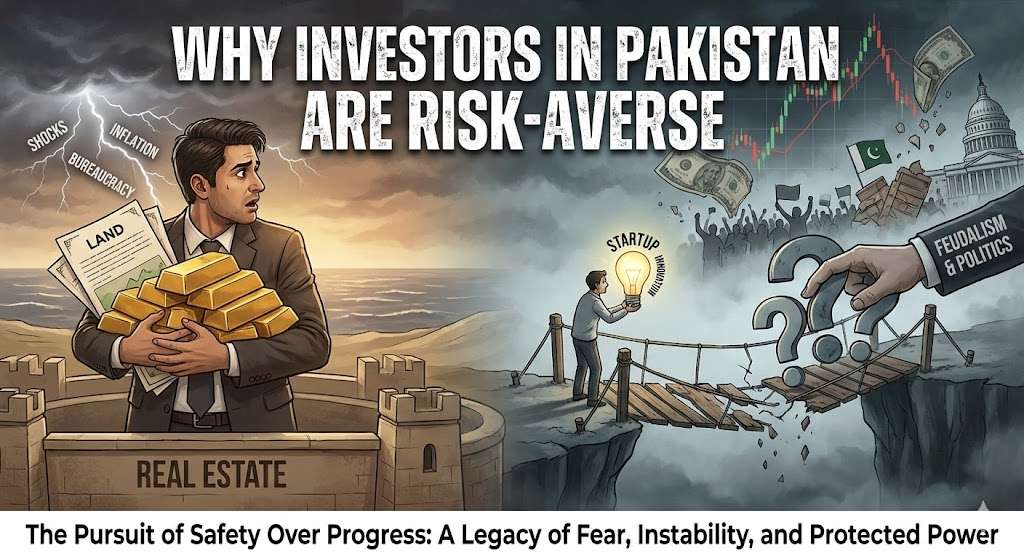

Why Investors in Pakistan Are Risk-Averse
In Pakistan, most investors don’t hate money, they hate uncertainty. And let’s not blame them for it because in an economy where rules change overnight and instability is prolonged, people naturally chase safety. That’s why property beats startups, stocks, and bold ideas every single time. This mindset is the pattern seen since ages and shaped by culture, power, and survival instincts.
Every Pakistan’s investment pattern is summed up in this one simple emotion: fear of losing what little stability he has managed to build. Inflation is at an all-time high and savings is the worst way to lose your money.Moreover, every government that comes in charge brings new policies without warning. In such a situation, taking risks looks really stupid. So most people play defense, not offense.
Shocks, Shocks and more Shocks
Pakistan’s economic history has trained investors to expect shocks. Over the last 70 years we have faced every monetary nightmare, including currency devaluations, sudden taxes, stock market crashes. Now when you are surrounded with risks amplifying from everywhere, you don’t want to risk your money at all. And this is exactly what people do. People want assets they can see, touch, and explain to their families. Anything that depends on systems, institutions, or “future potential” immediately feels unreliable. You have not seen tomorrow, and you never know.
Risk Tolerance in Pakistan
A study conducted by the Journal of Business and Tourism indicates that risk tolerance in Pakistan is generally moderate to low, and we have explained why.
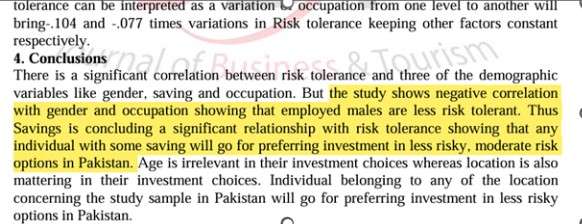
Men tend to take slightly more risks than women. People with higher education are more open to risk, but even they hesitate once real money is involved. Income matters too. Wealthier individuals can afford mistakes, so they experiment more. Everyone else sticks to what won’t make them bankrupt overnight.
This mindset spills into career choices as well. From a young age, people are pushed toward “safe” professions. Government jobs, corporate roles, medicine, engineering. Entrepreneurship is rarely presented as a respectable first option. The education system trains employees, not problem-solvers. The national education system promotes rote-learning. It is designed in a way where text-book memorization is rewarded and creativity and experimentations are punished.
The Biggest Barriers to Entrepreneurs
Bureaucracy becomes a curse
Then there’s bureaucracy. Starting a business in Pakistan is mentally exhausting and monetarily draining. Paperwork, inconsistent regulations, corruption, and unclear tax rules kills the momentum before it is built. For many potential entrepreneurs, the risk of the business failing comes later; the first and foremost risk is getting stuck fighting the system before the business even starts. And you cannot fight the system, can you?
Fear of Failure
Social pressure seals the deal. Failure carries a heavy stigma. A failed startup prejudices your potential. It is not counted as an experience, and a learning matrix but seen as a proof of irresponsibility and incapability. Families, relatives, even spouses judge harshly. So people avoid risk not because they lack ambition, but because the cost of failure is socially and financially brutal.
When you combine economic instability, weak institutions, cultural expectations, and fear of judgment, risk aversion stops being a weakness. It becomes a survival strategy.
Real Estate: The Safest Investment in Pakistan
People trust land and buildings
This is where property enters the picture and quietly dominates the entire investment conversation in Pakistan. Real estate becomes the only choice for people to invest everything they could save over their lifetime. In this country people don’t trust systems anymore, they trust land and buildings. Because they are permanent, you can feel them, stand on them, point to them. And no change in policy can erase them overnight.
Property is an Independent Market
Unlike stocks, property isn’t directly dependent on political speeches or global market variations. Prices may stall for the time being, but they rarely collapse instantly. That slow movement gives investors psychological comfort, an assurance, at least, that their money is not losing value. Even when markets are down, people sleep better knowing their money is safe.
Property Value is in a direct correlation with Inflation
Property also aligns perfectly with Pakistan’s inflation problem. As the rupee loses value, land prices usually climb. Rents go up. Replacement costs increase. For many families, real estate has been the only reliable way to preserve wealth across decades. That track record matters more than any financial theory.
Another reason property wins is flexibility. Installment plans, informal financing, family pooling, and delayed possession options make entry possible even for young or middle-income buyers. You don’t need financial literacy to understand it. Buy, hold, rent, wait. It’s simple, familiar, and socially accepted.
The Social stigma
There’s also the legacy factor. Property is a symbol of status and security. Parents want something tangible to pass down. A house or plot carries respect in a way a stock portfolio never will.
Collateral value plays a huge role too. Banks are far more willing to lend against property. Land unlocks credit, leverage, and liquidity when needed. A startup can fail and leave nothing behind. A house can be sold, rented, or mortgaged.
Most importantly, property doesn’t demand constant attention. You don’t need to track markets, read balance sheets, or worry about insider manipulation. In a low-income economy, that low-maintenance nature is gold.
And these factors explain why investing in property is a rational behavior shaped by history.
The Real Challenges of Building a Business in Pakistan
While property feels safe, high-risk entrepreneurial ventures in Pakistan feel like walking into a storm. Startups, new businesses, and innovative ideas face market risk and a lot of systemic resistance at every step. The odds are stacked over one another and a layman with only a handful of capital withdraws before even entering the market.
The rigged system
The first barrier is corruption and policy chaos. Rules change without warning, licenses get delayed. Every step depends on connections or bribery rather than compliance. A business plan can be solid, demand can be real, but one bureaucratic decision is enough to shut everything down. That kind of uncertainty kills entrepreneurial momentum fast.
Capital Unavailability
Then there’s the funding problem. Venture capital in Pakistan is limited and conservative. Investors want quick exits, guaranteed returns, or collateral-backed safety. These things are rarely offered by any startups. Banks won’t lend without property, and angel investors are cautious because legal protections are weak. If things go wrong, recovery is slow or impossible.
Failure means no potential
Social pressure makes it worse. Failure is not treated as a learning curve but as a personal flaw. A failed entrepreneur is labeled careless, immature, or reckless. We have pondered over this earlier as well. Compare that to someone in a stable job. They may earn less, but they are stable. That difference matters deeply in family-centric society.
The job market reinforces this behavior. Secure roles in government, multinational firms, or established businesses are glorified. Young people are taught to “settle first, build capital and then experiment later” but that later rarely comes. By the time stability arrives, risk tolerance disappears.
Even marriage and social status play a role. Entrepreneurship doesn’t carry the same prestige as traditional professions. Parents prefer a predictable income over potential.
All of this creates a feedback loop. Fewer startups succeed, so fewer role models exist. Fewer role models mean less interest of the young generation in entrepreneurship. And all of this pushes capital right back into property and safe assets.
Feudalism and the Concentration of Land Power
Apart from the attitude of the society towards entrepreneurship, there are more factors highlighting why risk-taking stays limited in Pakistan. To understand them, let’s look at the feudal structure sitting quietly in the background. Agriculture is still a major part of the economy, but it’s controlled by a small group of large landowners. These families are the feudal lords. They don’t just own land, they control votes, local power, and political outcomes in rural areas.
What’s interesting is that these feudal elites aren’t stuck in villages anymore. They’ve diversified into urban real estate, industry, and commercial property while keeping their rural land as a power base. That land gives them political leverage, and politics gives them protection. It’s a closed, never-ending loop.
This setup discourages real economic risk-taking. Feudal wealth grows through control and extraction, not innovation. There’s no pressure to build new businesses, improve productivity, or compete globally when power already guarantees returns.
For the average person, this creates a distorted reality. When people see that ownership and influence matter more than innovation, they naturally copy the safest path.
So risk avoidance became a learned behavior, shaped by an economy where power is restricted in a few hands.
The country’s elite, whether feudal families, industrialists, or big business groups, don’t chase risks the way entrepreneurs do. They chase protection. And politics is the safest place to get it.
Political Influence and the Protection of Failure
For these groups, entering politics was never about serving the country. It was only about serving their own selves. Through control, power and connections that political fraternity will provide. Getting into politics means access to favourable regulations, easy bank loans, tax relaxations, and immunity when things go wrong. That’s why politically connected companies borrow more and default more, yet survive. The system cushions them.
Pakistan has seen this pattern repeat for decades. In the 1990s, politically connected business groups routinely took massive bank loans under state influence. When governments changed, those loans turned into non-performing assets, but consequences were rare. The banks absorbed the losses, taxpayers paid the bill, and the same groups stayed powerful.
A more recent example is the rise of sugar barons in politics. Many major sugar mill owners are infamous parliamentarians or ministers. Their mills rack up debt, delay payments to farmers, and still receive subsidies, bailouts, or export incentives. Whenever losses accumulate, policies are quietly adjusted. If a normal entrepreneur ran a business that way, they’d be finished.
The same story shows up in energy and construction. Independent power producers signed guaranteed contracts in the 1990s that locked the state into fixed payments for decades. Even when costs dropped or demand changed, those contracts stayed untouched because the players were politically insulated.
So when people see that influence protects failure, while merit doesn’t protect success, they learn fast. Real risk-taking looks foolish when the system rewards proximity to power more than performance.
Conclusion
In the end, capital flows toward politics, not productivity. And as long as influence remains more profitable than innovation, Pakistan’s economy will keep choosing safety over progress.
It’s not that Pakistan lacks talent or ideas. It just has an environment where failure is fatal and risk is punished. Until that changes, innovation will always take a back seat to survival.
Author: Azan Ahmed
Level: CAF (ICAP)
This article is submitted by the author as part of the Nashfact National Writing Competition. Views expressed are the author’s own.