

- 6 February 2026
- No Comment
- 671
Why Handshake Deals are Financial Suicides

“Yaar Apna Hi Banda Hai” Where Most Business Disasters Begin
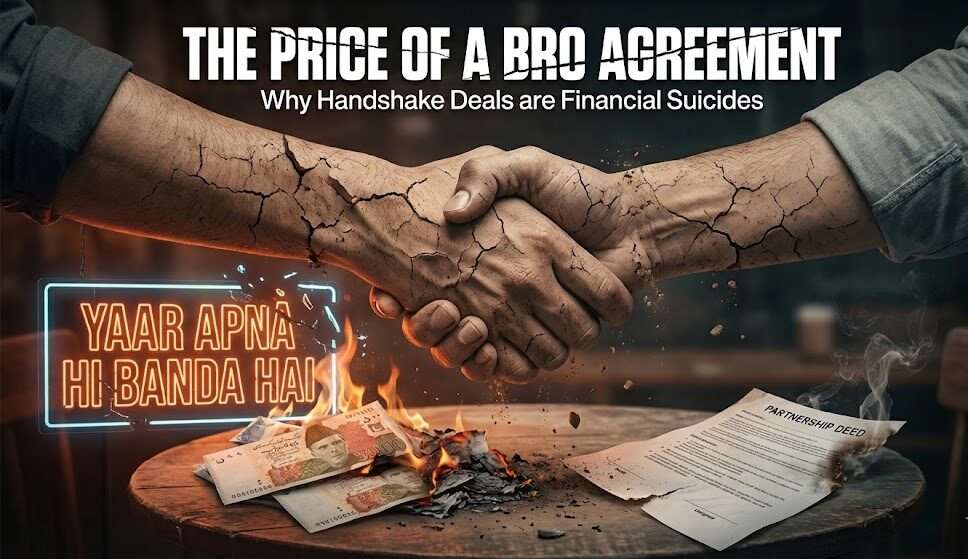
Every CA student in Pakistan has heard this line at least once: Yaar tension na lo, Apna hi banda hai. (Friend don’t worry. He’s one of us)
Usually, this sentence is spoken right before money changes hands, a business begins, and absolutely no document is signed. Two friends sit together at a cafe. One has the savings and the other has an idea. They talk about profits, growth, and freedom. They shake hands and promise honesty. No agreement. No rules. No clarity. Just trust.
At the start, everything feels exciting. Over time, the business might still exist but the friendship doesn’t. This is the real price of a bro agreement. It isn’t just the financial loss, it’s the emotional damage, the stress, and the permanent distance between people who once trusted each other completely. What feels like trust in the beginning quietly turns into assumption, and assumptions are the most expensive currency in business.
The Typical “Bro” Partnership Setup
As CAF students, we study the Partnership Act to pass our exams. But in the real world, partnership failures don’t happen because of a lack of knowledge of Act. They happen because of a predictable and risky pattern:
- One friend brings the Capital.
- The other brings the Time/Skill.
- Profit sharing is a verbal 50-50 split.
- The fatal flaw:No discussion on losses, salaries, or an exit plan.
This is not a partnership built on bad intentions. It is a partnership built on missing structure. Both partners believe their friendship is a shield against conflict. In reality this lack of structure is the first step toward a financial disaster.
Why Verbal Agreements Fail the Finance Test
Verbal agreements depend on memory and emotion. In finance memory is a liar. Without a written Partnership Deed basic questions become weapons:
- Can a partner withdraw cash (Drawings) for a personal emergency?
- Who controls the bank account?
- Who is responsible if a customer sues the business?
Case 1: Equal Profit, Unequal Effort
The Scenario: Consider Ali and Hamza, two close friends who start an online smartphone accessories business. Ali invests Rs 600,000 of his savings. Hamza runs the business daily, manages suppliers, and handles customers. They agree to share profits equally.
The Disaster: In the first few months, things go well. But slowly, the Effort Gap appears. Hamza is working all day while Ali visits once a week just to check the cash. Hamza feels exploited: I am doing all the work why is the profit the same? Ali feels offended: I took the risk if we lost money, it was my money on the line.
Both feel right, but both are suffering because nothing was clarified. Under the law, if there is no agreement, the law assumes profits are equal. A simple written clause about Partners Salary could have saved this friendship.
Case 2: The Intellectual Property (IP) Ghost
In today’s world, a business isn’t just a shop it’s a social media handle.
The Scenario: Consider Bilal and Zain. Bilal is the creative one he spent nights designing the logo and naming the brand. Zain is the tech guy set up the Instagram and Facebook using his own phone number and email.
The Disaster: After sometime, they have a falling out. Bilal says “It’s my brand name, I’m taking it. Zain replies, Good luck, the Instagram account is linked to my personal ID. It’s staying with me. Because they didn’t have a Partnership Deed, they are stuck in a digital deadlock. Bilal has a name but no audience; Zain has an audience but no legal right to the name. This is the “IP Ghost.”
Without a paper saying the firm owns the digital assets, your hard work is just one password change away from disappearing.
Case 3: The Side Hustle Business
In Pakistan’s agency culture, the Side-Hustle is a silent partnership killer. Under the Partnership Act, any profit made from a competing business belongs to the firm but in a Bro Agreement, this rule is ignored until it’s too late.
The Scenario: Sameer and Syed run a marketing agency. Sameer (the Face) meets a client at a wedding. Instead of bringing the project to the firm, he keeps it secret, hires a cheap freelancer, and pockets the Rs. 150,000 himself.
The Disaster: Syed discovers the secret project. Sameer justifies it: “I found the lead, so it’s my money.” Trust evaporates. Syed feels cheated.
A professional deed leaves no room for “personal projects.” It mandates that every lead belongs to the firm.
Case 4: The “Implied Authority” Trap
Under the Partnership Act, there’s a scary thing called Implied Authority. Essentially, it means your partner can sign a deal, and it’s legally as if you signed it too.
The Scenario: Take Omer and Ali. They sell construction supplies. Omer, wanting to look like a big player, signs a massive credit deal with a supplier at a sky-high interest rate. He doesn’t tell Ali because he wants to surprise him with the growth.
The Disaster: The project flops. Now, the supplier is at Ali door demanding money. Ali is shocked he never signed that paper! But legally, he is just as responsible as Omer. In a Bro Agreement, you’ve basically given your friend a blank cheque with your life savings.
A professional deed would have a simple rule: “Any deal over Rs.50000 needs both signatures.” Without that one line, your friend’s overconfidence becomes your financial grave.
Case 5: “Emergency” Withdrawals That Destroy Trust
Ayesha and Sara start a clothing brand. One day Ayesha withdraws Rs50,000 for a family emergency thinking she will adjust it later. Sara feels uncomfortable but stays quiet to avoid a fight. Next month it happens again. Soon, Sara feels cheated, and Ayesha feels justified. The issue isn’t the emergency it’s the lack of a rule. Business money is not personal money. Without clear limits, discipline disappears.
Case 6: The Silent Partner illusion?
Many students believe being a “Sleeping Partner” is easy money. Take Usman, who invested in a friend café. He never checked the books because he “trusted” his friend. A year later the friend tells him the business is in Rs2,000,000 loss. Because of Unlimited Liability, Usman is now personally responsible for debts he didn’t even know existed. In a partnership, you aren’t just partners in profit; you are partners in debt.
The “Bro-Proof” Checklist: 10 Questions to Ask Before You Shake Hands
If you are starting a venture/Business, sit down and answer these ten questions. If you can’t agree on these now, you won’t agree when millions are at stake.
- The Sweat vs Cash Ratio:How do we value work vs money? Should the working partner get a salary before profits are split?
- The Banking Protocol:Who signs the cheques? What is the spending limit for a single partner? (e.g: any expense over Rs10000 needs dual approval).
- The “Emergency Exit” Plan: If one partner wants to leave (perhaps fora Big 4 induction), what is the notice period? How is their share valued?
- Personal Drawings:What is the monthly limit for personal cash withdrawals to ensure the businessremains liquid?
- Authority Limits:Can one partner hire a relative or sign a lease without the other’s consent? The Act defines implied authority, but you should explicitly limit it.
- Dispute Resolution (ADR):If we fight, who is ourThird Umpire? Choosing an arbitrator.
- Asset Ownership:If I bring my laptop, does it become firm property? Who keeps the domain name and social media handles?
- The Death Clause:If a partner passes away, does the firm dissolve (As per the Act), or does a family member join?
- Weekly Reporting:Will we have a “Saturday Sync” to review every receipt and bank statement? Transparency kills suspicion.
- The Non-Compete Agreement:If we split, can my partner start the exact same business next door?
Legal Theory Vs Bro Reality
| Concept (Textbook) |
The Bro Trap (Reality) |
The Professional Solution |
| Mutual Agency |
Your partner takes a loan in the firm’s name. |
Written limits on borrowing power. |
| Unlimited Liability |
You lose your personal asset (bike/car) to pay firm debts. |
Formal indemnity clauses and registration. |
| Profit Sharing |
We’ll see how it goes leads to a fight. |
A fixed ratio (e.g 60:40) in the Deed. |
| Dissolution |
Entering is easy leaving is a legal war. |
A clear exit and valuation formula. |
Conclusion: Write It or Regret It
A handshake feels good, but a signature protects. Friends avoid written agreements because they fear hurting feelings, but in reality agreements protect friendships. Friendship is emotional, but business is functional. A simple written agreement prevents misunderstanding and saves mental peace. The real cost of a “bro agreement” is not just the money it’s the years of trust and the professional reputation you can never get back.
Good finance saves relationships. Bad finance destroys them.
In the courts of Pakistan, “yaar” is not a legal term. Judges don’t care about verbal promises they care about the stamp paper you signed.
Author: Syed Maqbool Hussain
Level: CFAP (ICAP)
This article is submitted by the author as part of the Nashfact National Writing Competition. Views expressed are the author’s own.