

- 5 December 2025
- No Comment
- 235
The Dirty Secret Cost of Your AI Assistant
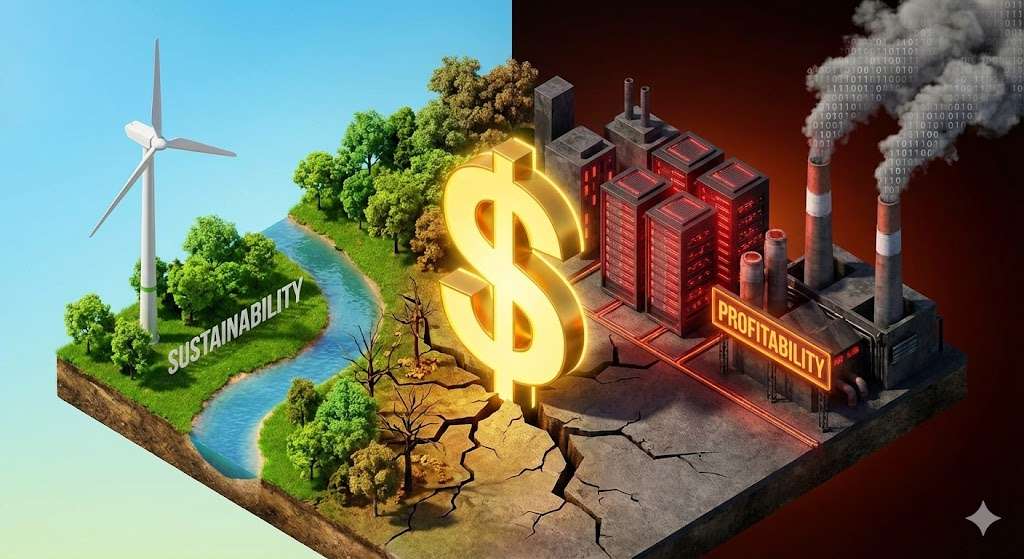

The New Battle: Sustainability vs. Profitability in Tech
If you listened to the CEO of any major tech company three years ago, the future was clear: it was going to be green, clean, and carbon-neutral. There were flashy PowerPoint presentations about “Net Zero by 2030” and sleek videos of wind farms powering server rooms.
But in 2025, that narrative has hit a brick wall.
A new war has broken out in Silicon Valley. On one side, you have Sustainability, the promise to save the planet. On the other side, you have Profitability, specifically, the massive, energy-hungry profits promised by the AI boom.
And right now, the planet is losing.
We are witnessing a clash between the environmental values tech companies claim to hold and the economic reality of the Artificial Intelligence arms race. Here is what that battle looks like from the front lines.
-
The Broken Promises of “Net Zero”
For years, we were told that our digital lives were “clean.” Unlike oil or manufacturing, the internet felt invisible and weightless. But the cloud is not a cloud; it is a physical network of massive, hot, noisy buildings called data centers. And right now, they are burning more energy than ever.
The rise of AI has thrown a wrench into the climate goals of Big Tech. Training a single AI model requires an astronomical amount of electricity.
- Google admitted in its 2025 sustainability report that its carbon emissions have actually increased by 51% since 2019, shattering its “Net Zero” dreams; however, an independent analysis by the Kairos Fellowship argued the true increase was closer to 65%.
- Microsoft and Amazon are in the same boat. Their emissions are rising because they are building data centers faster than they can find renewable energy to power them.
It turns out, you can’t have an AI revolution without breaking a few eggs, or in this case, burning a lot of fossil fuels. Research suggests that the real emissions from these tech giants might be 7 times higher than what they officially report.
-
The AI Gluttony: Power and Water
To understand why this is happening, you have to understand the physics of AI. AI chips run incredibly hot. To keep them from melting, you need cooling systems. Most of these systems use water, millions of gallons of it.
- A typical large data center can consume up to 5 million gallons of water per day. That is enough water for a town of 50,000 people.
- By 2030, the demand for electricity to run these AI centers is expected to double, consuming as much power as the entire country of Japan.
This has created a bizarre situation where tech companies are buying up land in drought-stricken areas to build facilities that drink the local water supply, all to power the chatbots we use to write emails.
-
The Money Shift: Why “ESG” Became a Dirty Word
A few years ago, the hottest buzzword in investing was ESG (Environmental, Social, and Governance). Investors wanted to put their money into “good” companies.
But in 2025, the mood has shifted. There is a massive “ESG backlash” happening on Wall Street.
- In the U.S., assets managed in sustainable funds have dropped significantly. Investors are pulling their money out.
- Why? Because “saving the world” doesn’t pay as well as “building the next super-intelligence.”
- In 2025, venture capitalists poured 8 times more money into AI startups than they did into Clean Tech startups.
The message from investors is brutal but clear: “We want returns.” If burning carbon makes more money than capturing carbon, the money will flow to the fire.
-
The “Greenwashing” Trap
Because companies know you care about the environment, they are trying desperately to hide this reality. This is called “Greenwashing”, using marketing to look eco-friendly while doing the opposite.
We are seeing a rise in “creative accounting” for carbon emissions. Companies buy “carbon credits” (paying someone else not to cut down a tree) to offset their own pollution, but often these credits don’t actually reduce emissions in the real world.
However, regulators are catching on. In the EU and the US, new laws are cracking down on these misleading claims. Companies can now face massive fines if they claim to be “carbon neutral” without proof.
-
The Human Cost: Tech Workers Revolt
The people most upset by this shift aren’t just the environmentalists; it’s the tech workers themselves. Many engineers joined companies like Amazon or Google believing they were working for ethical organizations. Now, they feel betrayed.
- More than 1,000 Amazon employees recently signed an open letter protesting the company’s “warp-speed” AI rollout, warning that it threatens climate goals.
- These workers are arguing that the company is prioritizing the “AI Arms Race” over the health of the planet.
This internal conflict is causing a crisis of culture. Sustainability teams are fighting with AI engineering teams for budget and resources. One side is trying to cool the planet; the other is trying to build a digital god that runs on coal power.
-
The Hail Mary: Nuclear and “Liquid” Futures
Is there any hope? Ironically, the solution to technology’s pollution problem might be… more technology.
Because solar and wind power aren’t reliable enough to run AI servers 24/7, Big Tech is turning to a controversial old friend: Nuclear Power.
- Microsoft and Amazon are signing deals to restart old nuclear plants or build new “micro-reactors” to power their data centers.
They are also changing how computers are built. New “Liquid Cooling” technology submerges servers in special fluids to keep them cool more efficiently than air conditioning.
The Choice Ahead
We are at a crossroads. The tech industry has realized that “Sustainability” and “Profitability” are currently enemies.
For the next few years, it seems the industry has made its choice: Speed wins. They will build the AI first and worry about the power bill (and the planet) later.
For the common reader, this means we need to look past the green logos and the Earth Day posts. The digital world is not magic; it is a physical machine that eats energy. And right now, that machine is getting hungrier every day.
The question isn’t whether AI will change the world, it certainly will. The question is whether we will have a livable world left to enjoy it.

Read more: The Real Reason Big Tech Is Firing Everyone
If you’ve opened a news app lately, you’ve probably felt a sense of whiplash.
One headline screams that a major tech giant just laid off 10,000 people. The very next headline cheers about a startup raising $500 million to build humanoid robots. Your LinkedIn feed is a graveyard of “Open to Work” banners, yet Wall Street is partying like it’s 1999 over Artificial Intelligence.
What is going on? How can the industry be dying and booming at the exact same time?
Welcome to Startup Winter 2.0. It is a strange, confusing time where the tech world has split into two different realities. In one reality, the one where most people work, it is cold, dark, and brutal. In the other reality, where the machines live, money is flowing like water.
To understand why this is happening, and why it matters to you, we need to look past the jargon and look at the money, the panic, and the people caught in the middle.